course · new for 2026
SuperForth for the Tatung Einstein

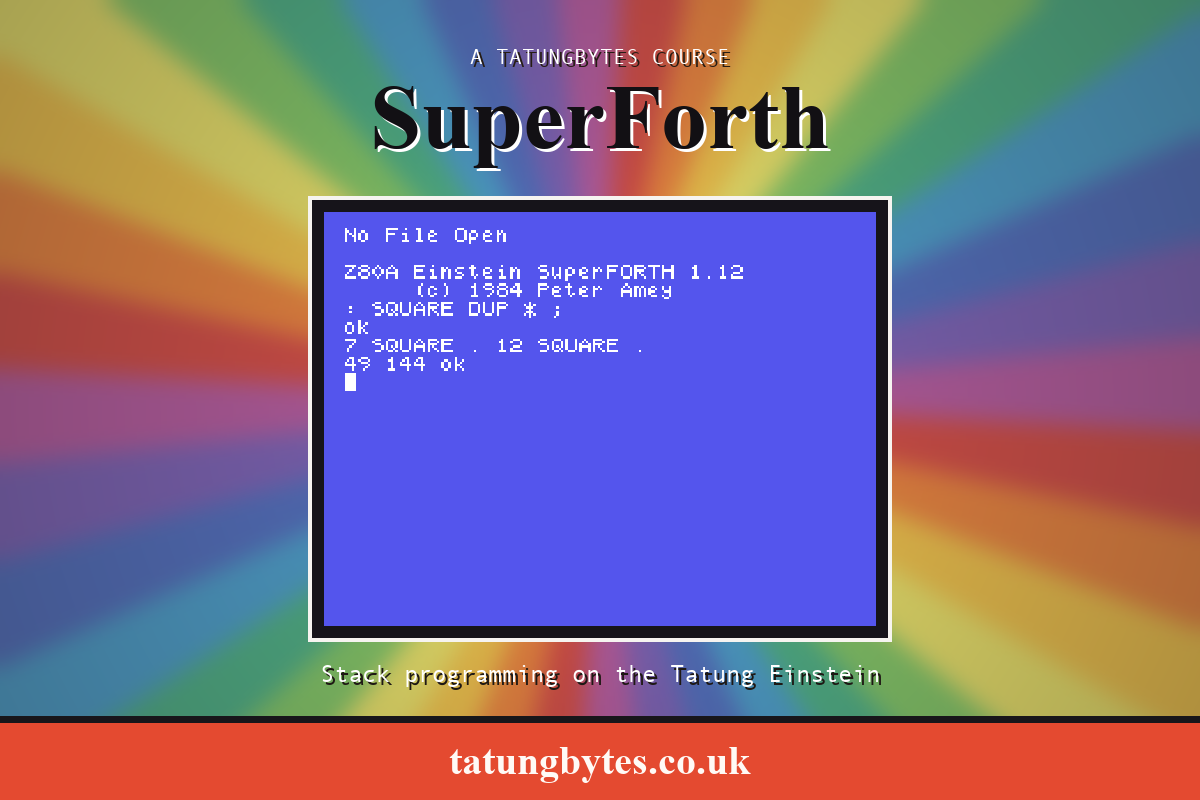
Forth is unlike anything else on the Einstein. You do not write programs so much as extend the language: you define new words in terms of the words that already exist, and the vocabulary grows until the thing you wanted to do is a single word. It is small, quick to answer, and famously strange to meet for the first time, and it sits much closer to the machine than BASIC does.
SuperForth is the Einstein's Forth, written by Peter Amey and published by Tatung's Einsoft label in 1984. It signs on as Z80A Einstein SuperFORTH 1.12. SuperForth went through more than one version and they differ; this course covers 1.12 and nothing else, and the course disc carries exactly that version.
You do not need to own an Einstein. Everything here runs on an emulator on your own computer, and everything you need is free.
Like our Dr Logo course, and unlike the Z80 assembly course which builds one game across thirty sections, this is a series of small self contained programs, each showing one thing clearly. That suits Forth, which is already a pile of small words each tried at the keyboard the moment it is written. It also means that if you stop after ten sections you have ten sets of working words rather than an unfinished program.
Thirty sections and four appendices. The first half is the language: the stack, arithmetic written backwards, defining your own words, keeping them on disc with SuperForth's screen editor, constants and variables, loops, true and false, decisions, and number bases. The second half is the Einstein: loading the extensions that came on the disc, asking for a number, random numbers and a guessing game, arrays, colour and redesigned characters, drawing, sprites, sound, floating point, and the function keys. It ends by reading Red Baron, the complete arcade game that came on the disc in 1984, and by building a SuperForth of your own.
Every section has the same shape: an explanation, a short listing to type, what you should see, a few single changes to make with a question attached to each, exercises, and the failures we actually hit. Worked solutions to every exercise are in an appendix.
It is written for both keyboards. Keys are called what the Einstein calls them, which is all you need at a real Einstein; wherever a key is somewhere else on a modern keyboard under MAME, a line beginning In MAME says where, and an appendix has the whole keyboard in one place.
Three things, all free: MAME, the Einstein ROM, and the SuperForth Course Disc from our Downloads page. The disc carries SuperForth 1.12, all the extension files it shipped with, a second copy of SuperForth with the editor already built in, and 80K of free space for your own work. It is an .mfi rather than a .dsk because MAME will not write to a .dsk - and SuperForth writes to its disc for everything beyond the keyboard, so on a .dsk the first thing you try to keep is lost. The second section sets all of it up, for macOS and for Windows.
The same way as the other two courses. Forth is an old language with many dialects, and SuperForth on the Einstein is its own specific product. So nothing here is taken from another Forth, from a general Forth tutorial, or even from the 1984 manual without first running it on the machine and watching what happens. Where a source and the machine disagree, the machine wins.
That mattered at once. SuperForth reads only the forty column row of the screen that the cursor is on, so a line of exactly forty characters is silently thrown away and answered ok - something no other Forth would lead you to expect and the manual mentions only in passing. True is 1, not -1. A counted loop always runs at least once. The arrow keys type square brackets, in the editor as well as outside it, where the manual says the cursor keys "function as expected". Sprites count their height from the top of the screen and the drawing words count from the bottom. The random number generator gives the same numbers every time the machine is started. Every one of those is in the course because the machine showed it to us.
Every listing and every suggested change was run on SuperForth 1.12 before it was written down, and so was every exercise solution except three changes to Red Baron, which are worked from its source and marked as such. Every screenshot is of the machine actually doing it. The sound sections were checked by recording the emulator's audio and measuring the pitch. More than sixty recorded experiments stand behind the thirty sections, and they are kept so that any claim can be checked again. What has not been done is a test on real hardware: the course was written and checked entirely under emulation, and if you follow it on a real Einstein we would like to hear what differs.
The software is in the library as SuperForth 1.12, and the original manual is archived as the Super Forth manual.
This course was written with Claude Code, directed and tested by Gavin Watson. We say so openly because we think it is the right way to use these tools, and because you deserve to know how the thing you are learning from was built.
