The Tatung Einstein never had just one BASIC. It came with one, a second turned up on the same disc, an upgrade and a compiler followed, and BASICs from Microsoft and Digital Research are listed in the library too. The Downloads library holds most of them, along with their manuals. This guide sorts them out: what each BASIC is, how to tell which one you are looking at, which manual goes with it, and which of our courses teaches it.
It is about the TC01. Where a BASIC has been booted and its sign-on read off the screen, the guide says so; where all we have is a manual or a library entry, it says that instead.
| BASIC | What it says when it starts | Where it came from | On this site |
|---|---|---|---|
| Xtal BASIC 4.2 | TATUNG/Xtal BASIC 4.2 (C) 1983 1984 | The System Master, in the box, 1984 | TC01 System Master Disc, and our Xtal BASIC course |
| Xtal BASIC 5.02 | Xtal BASIC 5.02 (C) 1983/84/85 | Crystal's System 5 upgrade | X-Master |
| Xtal BASIC Compiler 5.10 | Xtal BASIC Compiler Ver 5.10 | Crystal, 1987 | X-Master, and S33 of the Xtal BASIC course |
| BBC BASIC 2.31 | Einstein BBCBASIC Version 2.31 | R.T. Russell, 1984 | BBC Basic, and our BBC BASIC course |
| ZBasic 3.03 | ZBasic tm 3.03 BASIC Interpiler | Zedcor, 1986 | ZBasic |
| Microsoft and Digital Research BASICs | - | Microsoft; Digital Research | Manuals only; the programs are on the wanted list |
| CVBasic | - | A modern cross-compiler, 2024 on | CVBasic guide |
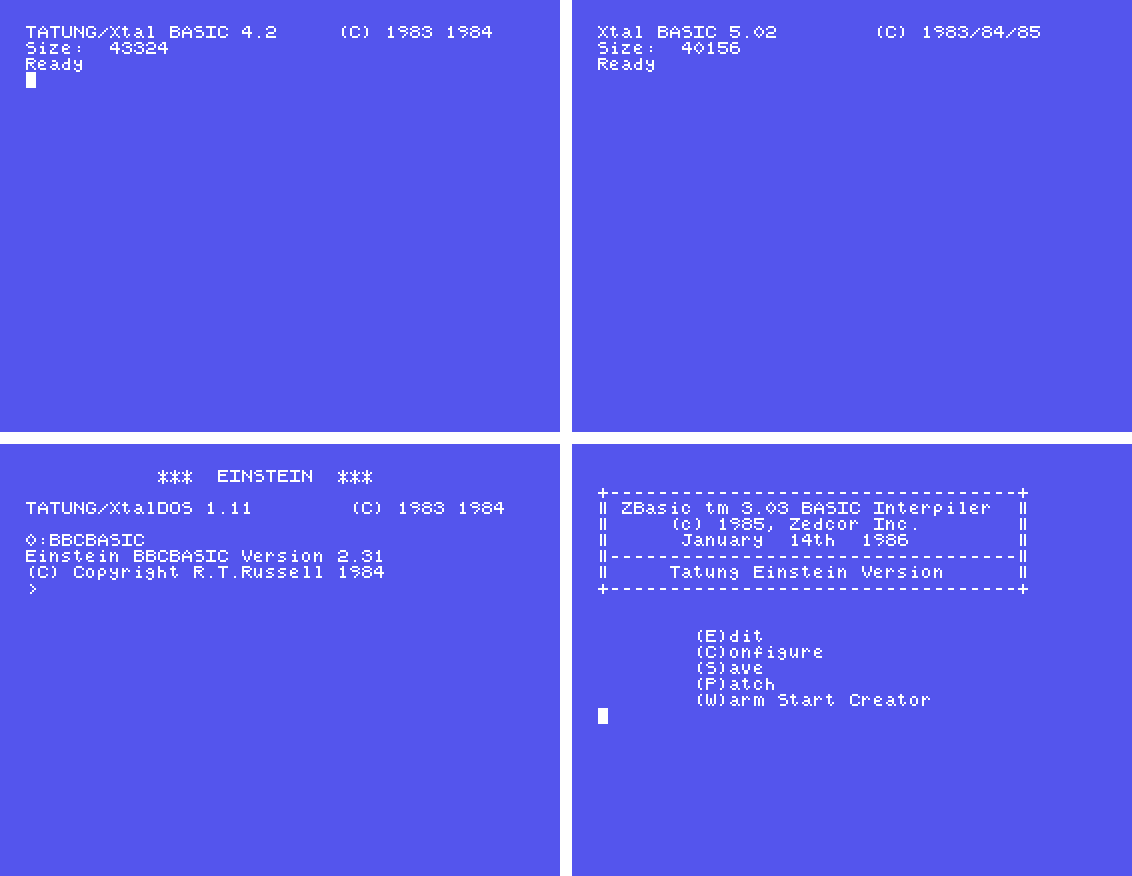
This is the Einstein's own BASIC. It was written by Crystal Research of Torquay, whose products carried the name Xtal, and it is XBAS.COM on the TC01 System Master Disc. Type XBAS at the 0: prompt and it answers:
TATUNG/Xtal BASIC 4.2     (C) 1983 1984
Size:  43324
Ready
It is the BASIC most owners actually used, and the one nearly all the type-in listings of the period were written for. Its programs are saved as .XBS files. It knows the machine: SPRITE, DRAW, ELLIPSE, FILL and POINT for the graphics, MUSIC, TEMPO and PSG for the sound chip, and CALL for machine code of your own. The nine programs Tatung put on the System Master, from Mastermind to Snakes, are written in it.
Its manual is the Tatung Einstein BASIC Manual (Xtal BASIC 4), Tatung's own 1984 reference by Alan Stancliffe, with an alphabetical entry for every keyword. Relatively BASIC goes further into its graphics, sprites and memory, and Additions to Xtal BASIC shows how to add commands of your own to versions 4.12 and 4.20.
Our Xtal BASIC course teaches 4.2 from the beginning and builds a platform game, Mouse In A Hole, with it. Everything in the course was run on 4.2 before it was written down, and it found a few places where the manual and the machine disagree.
4.2 was not the only release, and a few discs in the library carry traces of others. Card Sharp has its own XBAS.COM, 16,640 bytes, which calls itself TATUNG/Xtal BASIC 4.2 Version + PJW, and remnants of a 4.12 on the same disc. GrafDraw's XBAS.COM calls itself BASIC80 V4.3 (C) 1983-1986. Solo Software's Basic Tutorial and Merlin's Programmers Kit carry the words TATUNG/Xtal BASIC 3.18. Those names are read from the files; none of these versions has been booted for this guide. Software houses did modify the BASIC and ship it with their own programs, so if a disc brings its own XBAS.COM, use that one to run its programs.
Crystal followed 4.2 with a System Enhancements Package, Xtal System 5.0, and its BASIC is on the X-Master disc as a larger XBAS.COM, 17,408 bytes against 4.2's 15,616. Booted, it answers:
Xtal BASIC 5.02        (C) 1983/84/85
Size:  40156
Ready
The System 5 manual describes it as "designed to be upward compatible with the existing version 4", and documents only what is new: REPEAT and UNTIL, WHILE and WEND, CLS80 for an 80-column card, and more. The extras cost memory - 5.02 leaves 40,156 bytes free where 4.2 leaves 43,324, which is 3,168 fewer. John Marriott's letter of 2005 gives the same warning about "System5 DOS/XBAS".
A BASIC interpreter reads your program as it runs it, and that is why BASIC games on the Einstein move slowly. In 1987 Crystal released a compiler, which is also on the X-Master disc: XC.COM turns a saved .XBS into a compiled .XBI, and XR.COM runs it. Its manual is the Xtal BASIC Compiler 5.10 Manual.
The manual says it was written to support version 5 of the interpreter, and promises "a run-time speed improvement of 1.5 to 5 times". It also compiles 4.2 programs. Our Xtal BASIC course's platform game ran 1.7 times as fast compiled with the mouse standing still, and twice as fast with it walking; S33, Compiling The Game shows how, and the course disc carries XC and XR. It will not compile everything - EVAL is refused - and a compiled program's error messages have no line numbers, so the way to work is to write and test under the interpreter and compile at the end.
Compiled BASIC was sold, too. The Family fun pack from Solo Software ships each of its games as a .XBI with XR.COM beside it.
The Einstein also had a version of BBC BASIC, R.T. Russell's BBC BASIC (Z80), as BBCBASIC.COM. It is on the library's BBC Basic disc, and the same file is on the library's copy of the System Master. Type BBCBASIC at the 0: prompt:
Einstein BBCBASIC Version 2.31
(C) Copyright R.T.Russell 1984
>
It is a quite different language from Xtal BASIC, even where the keywords look alike. It has named procedures and functions (DEF PROC, DEF FN), REPEAT ... UNTIL, and variable names in which every character counts. Its keywords must be in capitals - print is answered Mistake. Disc commands start with a star (*DIR, *BYE), programs are saved as .BBC files, and ESC stops a running program. Its READ.ME is frank that full compatibility with the BBC Micro "is impossible" in graphics and sound, so a listing from a BBC Micro magazine will not necessarily run.
Its manual is the BBC Basic Manual (Z80), by Doug Mounter and edited by Richard Russell. Our BBC BASIC course teaches it by building a small text adventure, Drift.
ZBasic is Zedcor's, and the library's ZBasic disc is its Einstein edition. It opens not at a prompt but on a menu:
| ZBasic tm 3.03 BASIC Interpiler  |
|     (c) 1985, Zedcor Inc.        |
|      January  14th  1986         |
|     Tatung Einstein Version      |
        (E)dit
        (C)onfigure
        (S)ave
        (P)atch
        (W)arm Start Creator
"Interpiler" is Zedcor's own word. Its sample programs are .BAS files, and it has a help file on the disc, but no manual in the library. Beyond that sign-on it has not been tried for this guide.
The library also lists BASICs from two of the big names of the time: Microsoft's Basic Interpreter and Basic Compiler, and Digital Research's C Basic and C Basic Compiler (CBASIC). They are on the library's wanted list: no copy has been found yet, so none has been tried on the Einstein.
Two manuals go with them. The Microsoft BASIC Manual is Microsoft's reference. And the EXBASIC Manual (Microsoft BASIC-80 5.03) is for Microsoft BASIC-80 release 5.03 under CP/M, whose appendix gives its sign-on as BASIC-80 Version 5.03 (CP/M Version). The one-page MSBasic UnProtect Instructions belong with them.
The library's Einstein CP/M 3 disc is the CP/M operating system itself; it holds no BASIC.
CVBasic, by Óscar Toledo Gutiérrez, is a cross-compiler you run on a modern computer. It turns a BASIC program into an Einstein .COM file, and it targets a long list of other machines as well. It is a new language, not a period one, and its syntax is closer to QBasic than to Xtal BASIC. Our CVBasic guide shows how to use it for the Einstein.
The sign-on is the surest test, and the table at the top gives each one. After that:
.XBS is Xtal BASIC, .BBC is BBC BASIC, .XBI is a compiled Xtal program for XR, and .BAS is what ZBasic's sample programs use.XBAS.COM, in a DIR listing or on a download page: 15,616 bytes is 4.2 as Tatung shipped it, 17,408 is 5.02, and anything else is probably a version modified to go with the programs on that disc.Size: line Xtal BASIC prints when it starts: 43,324 for 4.2, 40,156 for 5.02.Xtal BASIC and BBC BASIC each save their programs in their own tokenised form, so a program saved by one cannot simply be loaded into the other. To move a program between them, it has to be retyped or converted.
To learn BASIC on the Einstein, or to type in a listing from an old magazine, use Xtal BASIC 4.2. It is what the machine came with, what almost all the period listings expect, and it drives the graphics, sprites and sound directly. Start with the Xtal BASIC course and its course disc.
To learn structured programming - procedures with parameters, loops that say what they mean, long readable names - BBC BASIC is the better teacher. Try the BBC BASIC course and its course disc.
To make an Xtal BASIC program faster, compile it. Our platform game ran twice as fast.
For real speed, no BASIC will do. Most of the games that moved smoothly were written in machine code, and our Z80 assembly course starts where the BASIC courses leave off.
| Manual | What it covers |
|---|---|
| Tatung Einstein BASIC Manual (Xtal BASIC 4) | Xtal BASIC 4 - Tatung's own reference, 1984 |
| Relatively BASIC | Xtal BASIC 4.2 in depth: graphics, sprites, memory |
| Additions to Xtal BASIC | Adding commands to Xtal BASIC 4.12 and 4.20 |
| Data File Handling | Files from Xtal BASIC; names no version |
| Xtal System 5.0 Manual | What Xtal BASIC 5 adds to version 4 |
| Xtal BASIC Compiler 5.10 Manual | The compiler, XC and XR, version 5.10 |
| BBC Basic Manual (Z80) | BBC BASIC 2.31 |
| EXBASIC Manual (Microsoft BASIC-80 5.03) | Microsoft BASIC-80 5.03 under CP/M |
| Microsoft BASIC Manual | Microsoft BASIC; names no release |
The general books - the Einstein Primer, The Source and the Einstein Compendium - all teach or use Xtal BASIC.