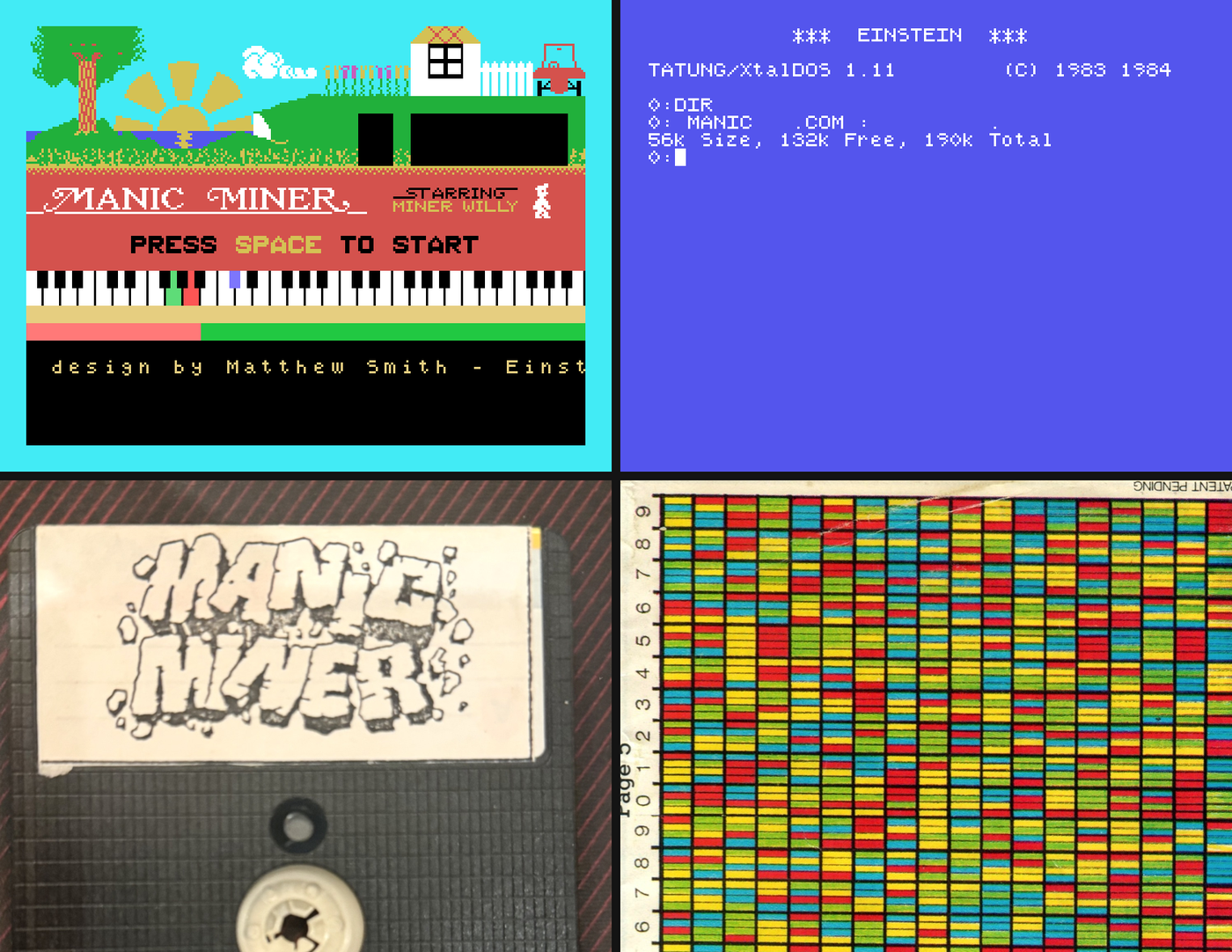
This week we put an original, boxed Einstein copy of Manic Miner through the Greaseweazle. Both sides read perfectly, every sector first time, and the disc is in the library as a raw flux dump with scans of its inlay. That was the plan. What we did not plan on was what else was on the disc, and where following it would lead.
A Directory with a Past
Type DIR on this disc and XtalDOS lists two files: MANIC.COM, and a second file with no name at all, shown as a bare dot. Read the directory as bytes rather than through DOS, and there are five entries, not two. Three are marked deleted: JETSET.COM, FASTMANI.COM and FASTJETS.COM. On this disc format a deleted file is a flag in the directory and nothing more; nothing is wiped, and the entry keeps its list of storage blocks. All three are still there in full.
The order they were written in is fixed by the disc itself. The Einstein's DOS hands out storage blocks lowest first, and the five files sit in one unbroken run: Manic Miner in blocks 1 to 14, Jet Set Willy in 15 to 28, the two FAST files after that, and the nameless copy of Manic Miner last, in 57 to 70. Had the three been deleted before the nameless copy was written, it would have taken block 15. So whoever prepared this disc wrote all five, then deleted three, and left it at that.
This Is the Master
It would be easy to assume a previous owner had used the disc as scratch space. The flux says otherwise. Both sides of the disc hold exactly the same 200K, byte for byte, deleted files and leftover data included. A home user copying a game does not duplicate it onto both sides with the debris intact. A duplicator pressing one master image onto every disc that leaves the factory does. The sector layout matches the other commercial original we have dumped, Electric Software's Backgammon & Norseman, and nothing formatted on a home machine. This is Software Projects' own master, faithfully copied, and every Einstein Manic Miner sold from it carries a complete Jet Set Willy that nobody was supposed to get.
Recovering the Deleted Games
Because the block lists survive, a deleted file can be rebuilt exactly, and we did: five files of 27,648 bytes each, in the recovered folder of the Manic Miner download. The deleted Jet Set Willy runs. Put it on a disc, boot it, and it asks for a code from its code book, just as it did in the shops. It is now in the library on its own, as Jet Set Willy (Original, with Code Protection), and the Manic Miner code sheet is printed on the inlay and scanned into that download at full resolution.
The FAST Builds
The two FAST files are the same two games with their speed governor taken out, and they are now in the library too, as Manic Miner FAST and Jet Set Willy FAST. A conversion like this is written to run as fast as the machine allows and then held back by a delay loop, so that it plays at the pace of the Spectrum original. FASTMANI.COM differs from the shipped Manic Miner in six bytes: four set that loop's counter of 1,616 to zero and change its exit test so it falls straight through, and the other two double the size of the code book the protection expects, from 850 squares to 1,700, which is Jet Set Willy's size. FASTJETS.COM differs from the shipped Jet Set Willy in a single byte, which zeroes a delay counter of 2,560. Nothing else changes. The nameless copy of Manic Miner is the shipped game with only the code-book change.
Why they were made is not written down anywhere we can find. Our reading is that they are the programmer's own working builds: the conversions run flat out, to test them and to see how much speed the Einstein had in hand before the delay was tuned to match the Spectrum. That is an inference from the bytes, not something the disc says. What we can say is that we searched the Tatung Einstein archives and the Jet Set Willy community sites for either file and found no trace of them, so as far as we can tell these builds have never been hosted anywhere before, on a Tatung site or any other, until now.
The People
The inlay also gives credits the disc does not: “Einstein translation by Cameron Else from the original Spectrum game by Matthew Smith”, artwork by Roger Tissyman. Else was the player who, with Ross Holman, took the Spectrum Jet Set Willy apart, found the bugs that made it unfinishable, and won Software Projects' completion competition with the fixes; the company hired him to write its MSX ports, and, this disc confirms, the Einstein ones too. The deleted Jet Set Willy sitting beside his Manic Miner on one master is, we suspect, his working disc.
Why Flux Matters
None of this survives in a conventional disc image. A .dsk made by copying the files, which is how most Einstein images in circulation were made, keeps what the directory admits to and drops the rest. A flux dump keeps what the drive head sees: every sector, every deleted entry, every byte of space the DOS had stopped caring about. On this disc that is a second game, two unreleased builds and both games exactly as they were sold, protection and all, forty years on. It is why we dump originals whenever we can get our hands on them, and why, if you have one, we would like to borrow it.
The dump was made with a Greaseweazle V4 and an original Einstein drive, and checked with our own Einstein Disc Tools.