Help Us Tell the Einstein's Story
Relatively Unknown is our book about the Tatung Einstein. Here is how far it has come, what we have found, and the questions only the people who were there can answer.
Relatively Unknown is our book about the Tatung Einstein. Here is how far it has come, what we have found, and the questions only the people who were there can answer.
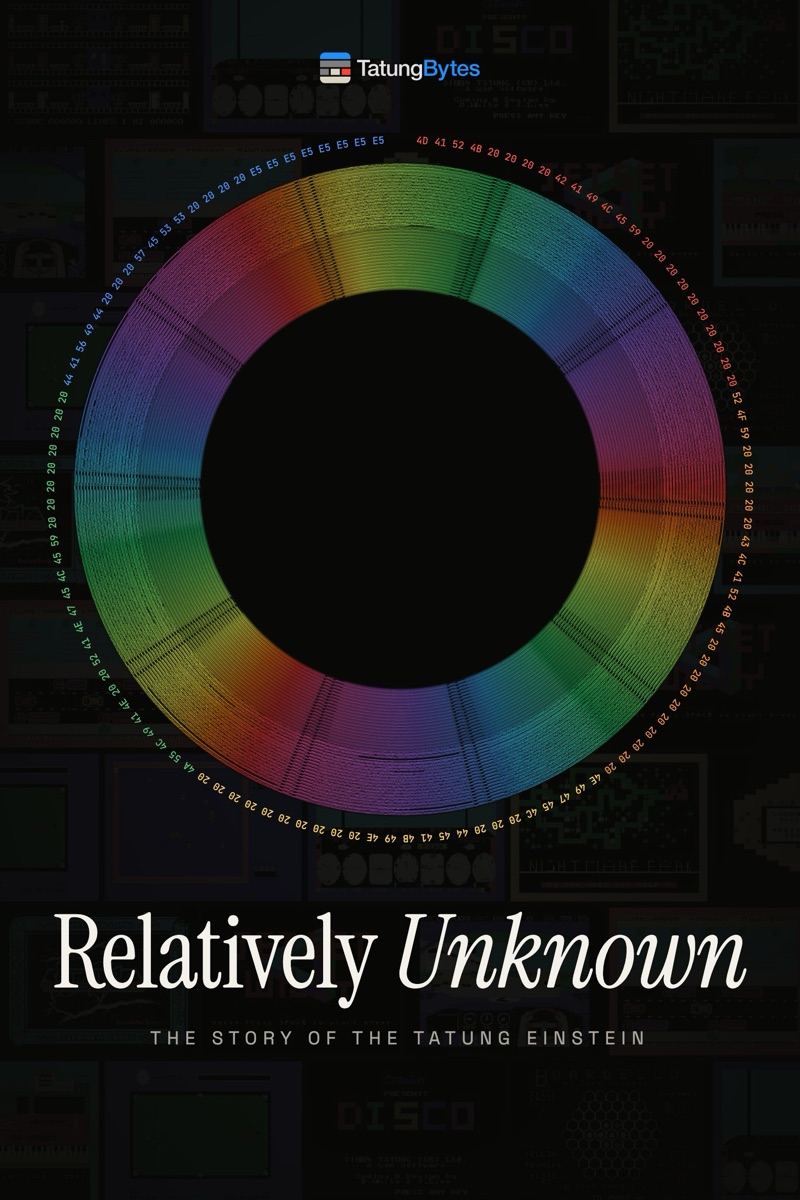
A book in progress
A British computer, designed in Bradford, built in Shropshire, and still loved by its owners forty years on. This is its story.
What We Still Don't KnowWe have been through the 1980s magazines, the local papers, Tatung's company accounts, patent records and the discs themselves. The story is mapped from start to finish, much of it is written, and it has turned up far more than we expected. What is left are the things nobody wrote down: the gaps only the people who were there can fill. That might be you.
Passages from the chapters already written.
Harrods, by Tatung's magazine's account, was "one of the first to sell the Einstein", with two staff "trained by Tatung". The man Tatung's magazine spoke to there explained how a department store came to sell computers at all, and his answer says a good deal about 1984: "We saw the writing on the wall towards the middle of 1983 and transferred all video games to the toy department and started selling micro-computers". The video games had gone to the toy department, and computers had taken their place.
On Wednesday 3 June 1981 the workers at the Decca television factory in Bridgnorth were called together and read a notice. The factory, it said, was to close with the loss of about 530 jobs, because the Taiwanese company that had taken it over two days earlier "had refused to complete the contract". Almost 300 of their colleagues had already been made redundant the Friday before. The town's biggest employer had been sold, and then, apparently, not sold.
Merlin's catalogue was mostly licensed from the bigger games houses, and its proudest title had a history. Tatung had shown a preliminary Elite on the Einstein in September 1985 and promised it the next month. It did not come. Merlin's did, in March 1987, and Tatung's magazine greeted it with relief: "At last! Elite is here. Not as a version for use with the Spectrum Emulator, as announced in the last issue, but a full-blown stand-alone version".
In its first selling season Tatung moved its whole operation from Bridgnorth to a new factory at Telford. By April 1985 it had merged its computer and television divisions there and made about 70 people redundant, about 25 of them in the computer side. On 24 April its deputy managing director, Michael Foster, blamed "problems in the TV and computer market".
Tatung had been hinting for seven months. In September 1983 it told the Shropshire papers that a computer "aimed at the corner shop user and for the home market" would be made in Bridgnorth early the next year, and by March 1984 the trade press knew "a home micro to be launched next month" was coming. Nobody would say what it was called.
Somewhere in the middle of Tatung's service manual for the Einstein is a sentence that explains the whole machine. "Because devices from a variety of manufacturers and microprocessor familes are used in the computer," it says, spelling and all, "some extra logic has been necessary ... to generate interrupt vectors for non-Z80A parts".
Every Einstein came with a System Master disc, and on the original 1984 masters the very last sector of the disc belongs to no file at all. It holds five names, each in a field of its own, and then nothing. ... Nothing on the disc reads them. ... It is the kind of thing engineers do when nobody is going to put their names on the box.
On 18 July 2004 an anonymous editor started the English Wikipedia article on the Einstein. It cited nothing. It said the machine was "designed and assembeled in the U.K. at Telford", released "in the summer of 1984", and that 5,000 were "exported back to Taipei later that year".
A machine can end with something a historian can point to: a last batch, a closing notice, a price list with the line struck through. The Einstein has none that anyone has found. ... Even the daily papers of the county that built it simply stopped mentioning it.
In fourteen years of messages in the online Einstein group, from 2006 to 2019, no poster said they had worked for Tatung, for Decca or for Dixons, and when a member asked in 2015, "Does Anyone know the true Story behind the Tatung Einstein", nobody answered.
Early in 1995 a pensioner wrote to the Einstein user group about a machine that had stopped. ... "I love my Einstein," the letter said, "and hope that I might yet find a monitor at a car boot sale, and so be able to use it again".
What the papers, magazines and discs tell us, and the gaps they leave.
Racal announces the sale of Decca's television business to Tatung for £1.1 million, including the Bridgnorth factory and a laboratory in Bradford.
The deal collapses: the Bridgnorth workforce is told the factory will close because Tatung has refused to complete the contract.
A new contract is signed and Tatung (UK) takes over the factory, a week late, with 540 jobs at Hospital Street.
Tatung's chairman, Dr T. S. Lin, asks the Bradford laboratory to develop a home computer; the printed account gives two dates that cannot both be right.
The first working prototype is built, but no dated document or photograph of it has been found.
Tatung announces a computer "aimed at the corner shop user and for the home market", to be made in Bridgnorth: the earliest public notice of the Einstein, still unnamed.
The name Einstein is chosen; no source from the time says why.
The Einstein is unveiled to dealers and the computer press at the Carlton Tower Hotel, Knightsbridge; the exact day is not known.
A new unit opens at Stanmore, Bridgnorth, to build the computer.
The design team writes version dates into the programs on the System Master disc.
The first batch of 450 Einsteins leaves the Bridgnorth production line.
Einsteins reach the shops, at £499 with a built in disc drive.
Tatung announces it is moving "lock, stock and barrel" from Bridgnorth to Telford.
Einstein User, the owners' magazine, publishes its first issue.
Tatung says 5,000 Einsteins have been shipped to Taiwan; whether they went, and how many, is not established.
Dixons advertises a complete Einstein outfit with a colour monitor for £499.99 in 280 branches.
Tatung cuts the price by £150 to £350, merges its computer and television divisions and makes about 70 people redundant.
The new Telford factory at Stafford Park is officially opened.
A preliminary Elite is shown on the Einstein at the PCW Show; the release promised for the next month does not come.
The UK Einstein User Group Newsletter begins.
How many Einsteins were made: no production figure has been found.
The Einstein 256 is announced, to be launched at the PCW Show in September.
The Einstein 256 launches at Olympia at £399 with a colour monitor.
Where the Einstein 256 was assembled, Telford or Taiwan, is not established.
Dixons clears the original Einstein at £129.99.
A reader finds the five names hidden on the System Master disc, and Einstein User prints the letter.
The last Dixons advert we have found puts the Einstein at £99.99, "HURRY LIMITED STOCKS".
B & H Computers of Halifax takes over Einstein User from Tatung.
When the last original Einstein was made: we have found no report of production ending.
What became of Tatung's remaining stock, tooling, drawings and papers.
Nothing on this timeline from 1989 to 1993.
105 Einstein 256 computers are auctioned at Ossett on the instructions of the Inland Revenue; whose stock they were is not stated.
Nothing on this timeline from 1995 to 2002.
Einstein Magazine No. 111 appears, the last issue we know of.
The first Wikipedia article on the Einstein appears, citing nothing.
Nothing on this timeline from 2005 to 2018.
The MAME emulator runs the Einstein 256.
Nothing on this timeline from 2020 to 2024.
A public domain recreation of the Einstein's main board is published.
We never guess. Anything you tell us is checked, credited if you wish, and kept private if you prefer.
Choose a part of the story to see its questions.
Everyone here is named in print as part of the Einstein story, and we have not yet been able to reach them. If you are one of them, or know how to pass a message on, please get in touch. We never publish contact details.
Industrial designer credited with the Einstein's styling (2004 book)
How the case was designed, and who asked for the monitor recess on top.
One of the five names hidden on the System Master disc, printed in Einstein User in 1987; signed programs on the same disc
What he did on the Einstein's design, and who else was in the team.
One of the five names hidden on the System Master disc, printed in Einstein User in 1987; signed programs on the same disc
What he did on the Einstein's software, and how the team worked.
Credited writer of Tatung's Einstein manuals (1984)
How the manuals were written, and from what.
Former technical director of Tatung UK; wrote "Birth of a Genius" for Einstein User (1988)
Why Tatung built a computer, from the top of the company.
Tatung UK's deputy managing director (1985)
The move to Telford and how the company saw the computer business.
Tatung's commercial manager (1985)
How the Einstein was sold, and to whom.
Tatung UK's general sales manager (1983)
The plans for a computer before it had a name.
Software projects manager at Tatung UK (1985), author of the Einstein Primer, later at B & H Computers
Tatung's software plans, Elite, and the hand over to B & H.
Technical support at Tatung UK, responsible for Einstein sales (1987)
The late years at Telford and when production stopped.
Editor of Einstein User under B & H Computers (from 1988)
How B & H came to take over the Einstein, and what it bought.
The firm that wrote the Einstein's operating system, disc system and Xtal BASIC
Who wrote which parts of the software, and how the work with Tatung went.
Bridgnorth, Telford or the Bradford laboratory: the line, the drawing office, sales, support
What it was like, and the photographs and papers nobody has kept.
Founder and first editor of the UK Einstein User Group Newsletter (1985)
How the national user group began.
Co-founder of the East Anglian Einstein Association (1986)
The user group years at Ipswich.
Chief editor and publisher of the UK Einstein User Group's magazines, New Romney (1990s)
The group's later years and its archive.
Editor of Einstein Magazine (2000 to 2002)
The last years of the printed magazine.
Ran the UK Einstein User Group stand at shows (1996)
The shows, and who came to them.
Produced EDI, the Einstein Diskmag International (1996)
The disc magazine and its contributors.
Ran an Einstein web site from about 2000; thanked for Tatung details in a 2004 book
Where his Tatung details came from.
Were you there?Even if your memory is not on our list, we would like to hear it. A name, a date, a photograph or a box in the loft can fill a gap in the story.
This form is protected by reCAPTCHA, and the Google Privacy Policy and Terms of Service apply.
