module
8
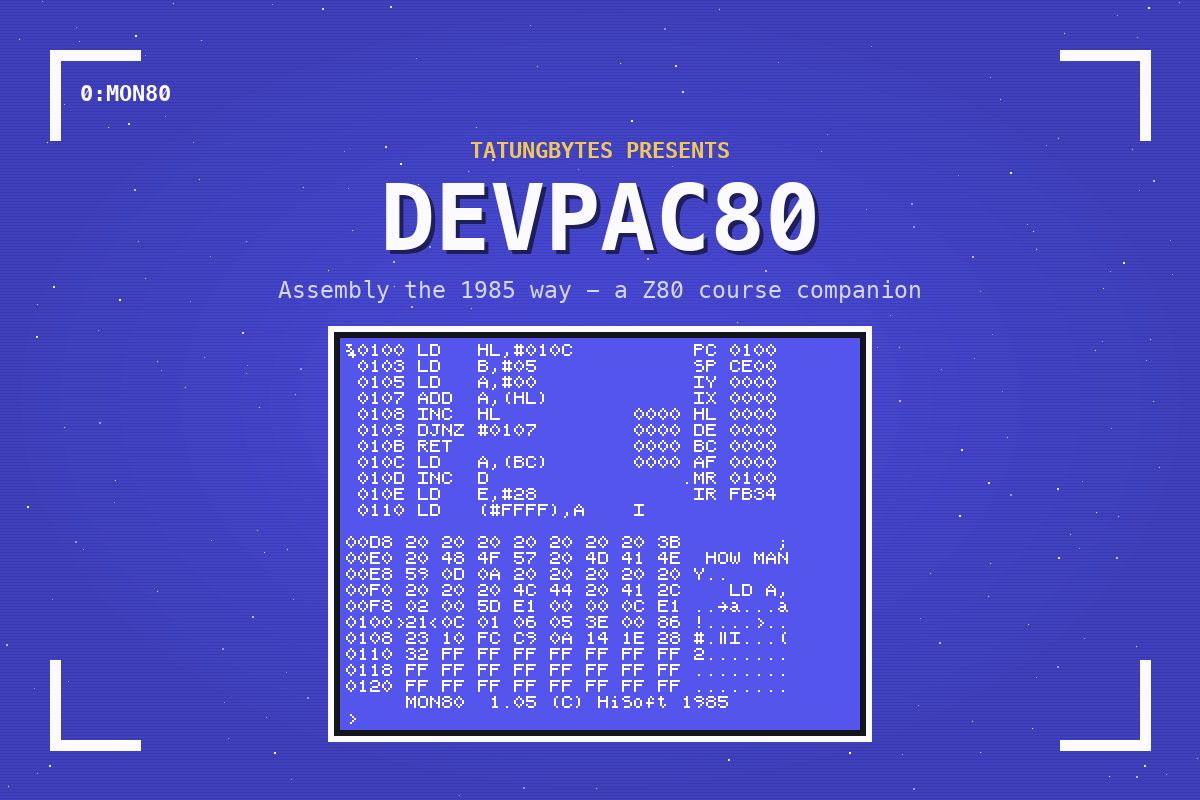
You have now written, assembled, run and debugged programs the way an Einstein owner did in 1985, with nothing but the machine and a disc. It is slower than pressing Run. It is also self-contained in a way the modern toolchain never is: everything you needed was on one disc in drive 0.
.BAK.The rest of the assembly course. Take the programs from S15 onwards - the screen, sprites, sound, the heartbeat, the game - and build them the same way, with Appendix II beside you. They are longer, which is where ED80's blocks and GEN80's *I earn their keep: S30's split into files becomes a handful of *I lines, one .GEN file each.
MON80 on a bigger program. Run a game to the start of its main loop with J, then step one frame with Z and watch its variables change in the dump. It is the debugger the assembly course's Appendix XI showed you in MAME, running on the Einstein itself.
The other assembler. The assembly course's Appendix XII covers Zen, which also ran on the Einstein. Put the two side by side and you have most of what an Einstein programmer of 1985 might have chosen from.
Edit, save, assemble, run, look inside: all on the Einstein, all from one disc.
