module
1
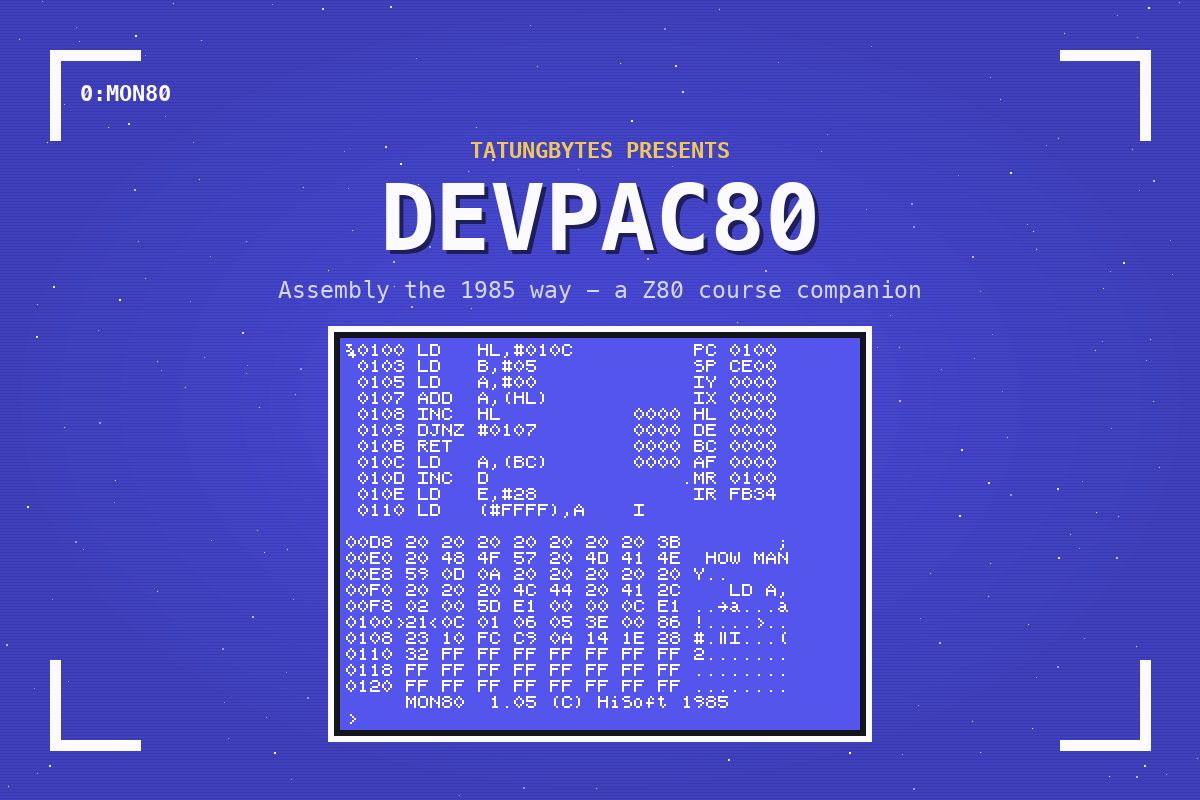
This companion is for someone who has finished the Z80 assembly course on this site. It does not teach Z80 again. You already know how to load registers, loop, call subroutines, walk a table and put a shape on the screen. What it shows you is how the same programs were written in 1985 - on the Einstein itself, with the tools of the time, and nothing else.
If you have not done the assembly course, start there. The sections here take programs you wrote in it and build them again, and they make much more sense once the program is an old friend.
It is short on purpose: eight sections and four small programs. The point is the way of working, not the programs.
In the assembly course you wrote in VS Code on a modern computer, pressed Run, and a second or two later your program was running on an Einstein in MAME. The assembler, the editor and the files all lived on your computer; the Einstein only ever saw the finished program.
Nobody in 1985 had that. If you owned an Einstein and wanted to write machine code, the Einstein was the computer you wrote it on.
Devpac80 was HiSoft's development kit for the Einstein: three programs on one disc, each doing one job.
| Program | What it does | It signs on |
|---|---|---|
| ED80 | A full-screen editor. You type your program into it and save it to disc. | - |
| GEN80 | The assembler. It reads your saved file and writes a .COM beside it. | GEN80 1.06 Copyright (C) HiSoft 1985 |
| MON80 | A monitor. It loads your program, shows it disassembled, and runs it an instruction at a time or up to a point you choose. | MON80 1.05 (C) HiSoft 1985 |
Between them they cover everything the assembly course's toolchain did - and MON80 does something the Run button never did, which is let you watch your program from inside.
The whole cycle happens at the Einstein's 0: prompt:
ED80 HELLO.GEN - type the program, save it.GEN80 HELLO - assemble it into HELLO.COM.HELLO - run it.MON80 to see why.Every one of those steps reads or writes the disc, so it is slower than pressing Run. It is also entirely yours: the Einstein, one disc, and no other computer involved.
Most sections take one program from the assembly course, say which, and build it again the 1985 way. The Z80 in it is the same as before, or very nearly: where GEN80 wants something written differently, the section shows you both and says why.
Each has The code - a listing to type into ED80 - with the exact commands to assemble and run it, and what you should see. Then Change one thing: a few small edits to try, each a question. Make the edit, guess what will happen, then assemble and see.
Listings are in capitals throughout, comments included, and they keep inside the screen's 40 columns.
S2 sets up the companion's disc and boots the Einstein from it.
