← Back to News
Every Byte Was Sacred: Pete Morris Remembers Tatung
The man who wrote Pete's Utilities worked at Tatung UK. Forty years on he got in touch, and sent us looking at the last sector of every System Master.
October 1, 2026
In September we put Pete's Utilities in the library, with a guide showing what each of its tools does. Not long afterwards, a message arrived through the site:
Author of Pete's Utilities here (plus ex staff at Tatung UK, and oft contributor to the Einstein magazine). Just here to say hello.
That is how we met Pete Morris, forty odd years after he wrote the programs. He has since sent us a long and generous account of his time at Tatung UK, and this piece is drawn from it. One line in it sent us looking at discs we thought we already knew.
Pete came to Tatung from British Telecom, where he was an engineer in what he calls a job for life. He had joined when it was still the General Post Office, so the pension was a state one. Giving that up in the early 1980s to go and work on home computers took some persuading, and the persuading came from two directions at once.
One was a friend who already worked at Tatung. The two of them used to spend evenings at his house hacking on an Apple II with a plug in Z80 board, and playing Infocom text adventures for weeks at a time. The other was Dr Roy Clarke, whom Pete first met not at work but over the air. Both were radio amateurs, and in the years before the internet that was how technically minded people found each other. Between them, the two of them talked him into it.
The team at Telford was small. Pete is clear that he did not work on the design of the Einstein itself, but he was part of the broader Einstein team, and he names the main movers as Dr Roy Clarke, Nigel Deakin as Software Engineer and Mark St.John Bailey as Senior Development Engineer, with those job titles taken from the user magazines rather than from memory. Nigel Deakin's name will be familiar to anyone who has looked closely at a System Master: it is on the Keyboard Trainer, including the 1984 build we recovered from a deleted disc last week.
By the time Pete arrived, Roy had moved down to Shropshire from Bradford, where Pete believes a good deal of the design work had been done. He is careful to say he does not know what was up there, or whether the others came south with Roy.
The same engineers were not only working on computers. They were also designing other Tatung hardware and writing the embedded code that went with it, including the software inside a television's remote control and the set it talked to. On every one of those jobs the discipline was the same, and Pete remembers it in the form of a Monty Python joke: every byte was sacred, every byte was good, and if a byte was wasted, Roy got quite irate.
He also remembers, with obvious warmth, a maintenance department full of young and creative engineers he used to go and sit with in another part of the sprawling factory. Their names have gone.
One line in Pete's account sent us looking. Writing about Roy, Nigel and Mark, he adds:
If I remember correctly, their three names are hidden somewhere on each original system disc, in a way that I think even a disk copy operation would not normally copy across.
He remembered correctly, and there was more there than he had promised.
The very last sector of an Einstein disc, track 39, sector 9, belongs to no file. On original System Masters it is not empty. It holds five names:
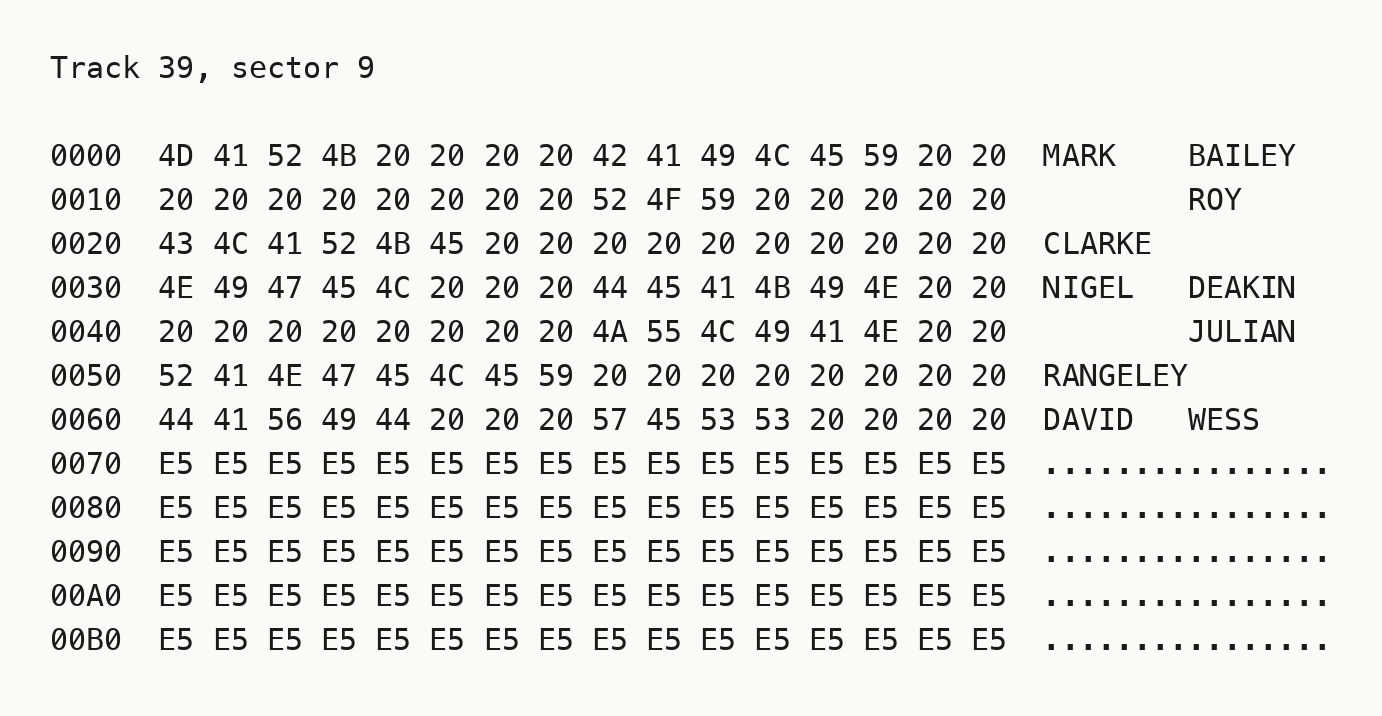
Each name sits in a fixed record of 24 bytes: eight for the forename, eight for the surname, eight of spaces. Where a sixth record would have begun, at offset 70, the sector turns to E5 and stays that way to the end of its 512 bytes. E5 is the byte an Einstein writes across empty space, so the filler is not padding anyone chose. It is simply where the list stops.
The first three are the names Pete gives as the main movers. Julian Rangeley appears in the first issue of Einstein User, listed at Tatung UK's laboratory in Bradford, which is the place Pete thought the design work had been done. David Wess was already quietly in our library without us noticing the connection: he wrote Hangman, one of the games on the System Master itself.
Shown the list, Pete's own reading of it is that all five were probably from the Bradford end of things, and that he does not think he ever met David, who may have stayed up there. If that is right, the sector is not a roll call of everyone who touched the machine. It is a snapshot of one laboratory.
Pete's note about copying holds, and it explains a good deal.
A file copy cannot carry the names. No file owns that sector, so as far as COPY is concerned there is nothing there to take. The Einstein's whole disc backup is a different matter, because it copies every sector regardless of what owns it. We tried it in MAME: the System Master's own 1984 backup program, from a master in drive zero to a freshly formatted disc in drive one whose last sector was nothing but E5. It reported Disc Backed up -- OK, all four hundred sectors matched, and the names were on the copy.
That is how they got about. The names are not only on System Masters. They are on Castle Quest, on the Programmer's Kit, on ZEN. Those discs were made by backing up a master and writing different files over the top, and the last sector travelled with them, unread, for years.
Not every disc has them: the XtalDOS image the site has been serving for years does not. Still open is whether FORMAT writes the names on its own, and which System Master versions carry them, which may turn out to be a way of telling an early master from a late one. Both are being looked at, and the backup test so far has been done in emulation rather than on a real machine.
How the names came to be written there at all, nobody now seems to know.
We were not the first to find them, and we were not first by thirty nine years.
Einstein User, Volume 3 Number 1, March 1987, carries a letter on page 31, on Dr Roy's problems page, under the heading The Secret's Out!:
Dear Dr Clarke,
Any prizes for finding the names of MARK BAILEY, ROY CLARKE, NIGEL DEAKIN, JULIAN RANGELEY and DAVID WESS on the last sector or the EINSTEIN Master Disk?
Name and address withheld
The reply printed underneath runs to four words. It is from the man who answered that page as Dr Roy, and whose own name is second on the list:
Congratulations; unfortunately no prize.
Dr Roy
The magazine printed the writer’s name and home town, as letters pages did then. We have left both out here, because he did not write that letter expecting to turn up on a website forty years later. If he, or anyone who knows him, would like the credit, we would be glad to give it.
So the names were found at the time, by a reader who simply wrote in, and Roy Clarke confirmed them in print. It took us a flux dump of the disc and a prompt from Pete. It took that reader a floppy and some curiosity, and the only reward on offer was being told there wasn't one.
Pete describes himself as a software person rather than a hardware one. He helped debug XtalDOS, the disc operating system, and MOS, the machine operating system, along with extensions to both Xtal BASIC and BBC BASIC. He supported third parties working on languages for the machine, Forth and Pascal among them. All of it, he says, was Z80 assembly language. Everything they did at Tatung was.
He also wrote for Einstein User, as did most of the team, and here is a detail worth knowing if you ever read those magazines closely: some of the articles were published under invented names, or with no byline at all. Pete thinks only one piece, about databases, has his own name on it. Forty odd years later he could not now say which of the rest were his.
Pete's Utilities were not written at work. They were written at home, in his radio shack, over a few evenings, with the local two metre amateur band on in the background. He describes that as a sort of technical Radio 4: mostly radio talk, with the occasional conversation about these new home computers that Sinclair's machines had made common.
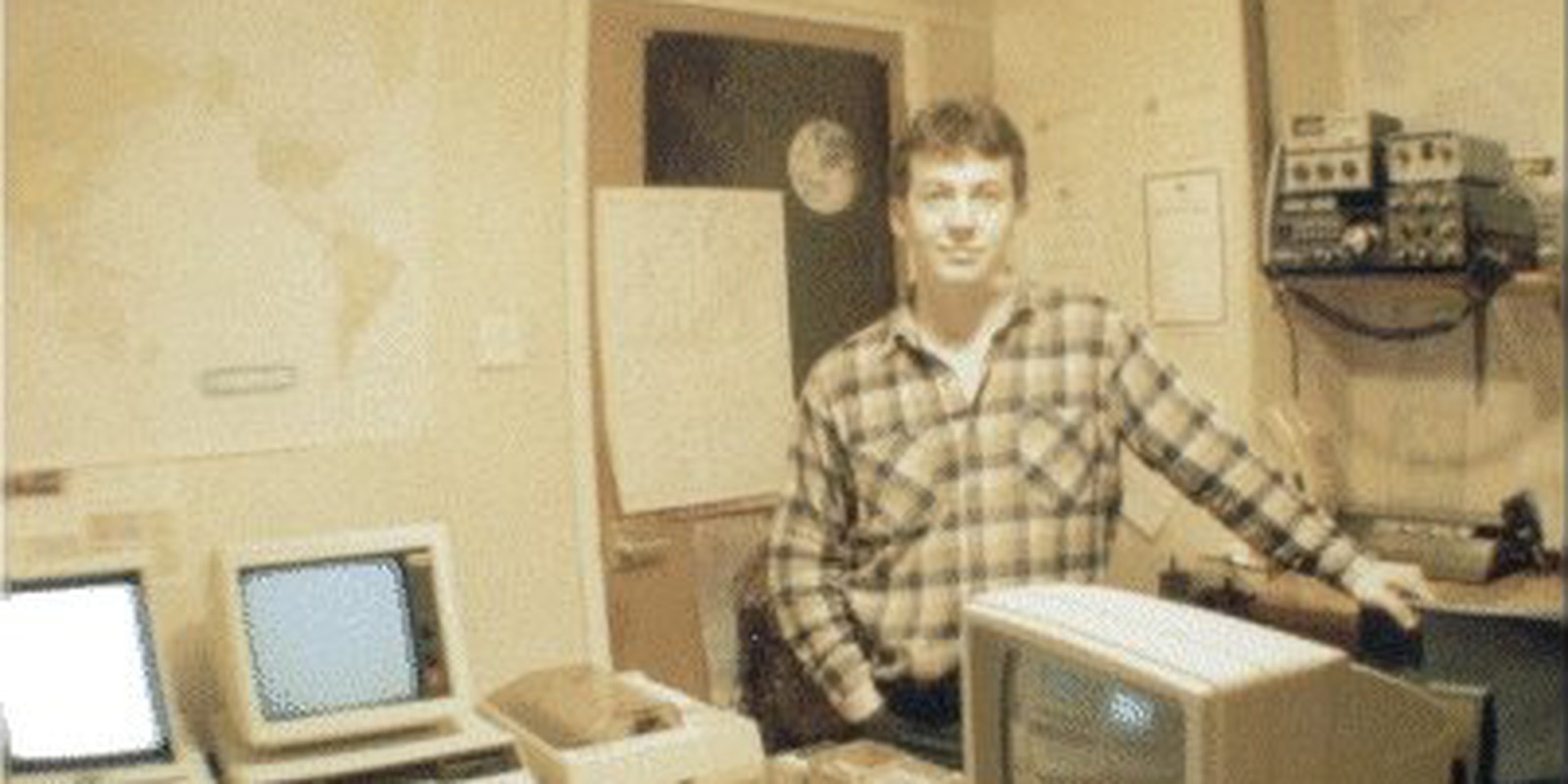
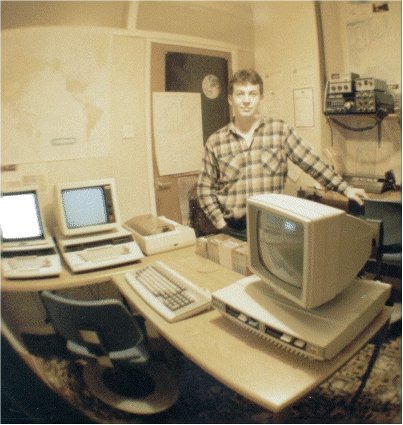
They were written in Z80 assembly on another Tatung machine entirely, a TPC-2000 running CP/M. The photograph below is his, taken from a blog he used to write and now preserved on archive.org. The TPC-2000 is in the foreground and the radio gear is behind him. He still has the printed code listings somewhere.
Where the ideas came from, he cannot remember. Some may have been asked for by users. Some he probably just wanted for himself.
They were published by Orion Software. The copy we hold is in Orion's own case, with an address in Burnley on the back, though the disc inside carries a Merlin Software label, which is a small puzzle we have met on other Einstein discs this week.
There is a happier footnote. While looking back through the magazines to remind himself of his colleagues' names, Pete came across a review of his own utilities by Dr S Berrisford, on page 17 of that same March 1987 issue. He had completely forgotten it existed. Volume 3, Issue 1 is also where he stopped reading, because around then his work moved on.
What it moved on to was Tatung's line of IBM PC clones, the TCS range: first an XT clone, later an AT clone. He is not sure he ever had a job title. Software Engineer, perhaps.
The clones were built around the ERSO BIOS, written by the Electronics Research and Service Organization, part of Taiwan's Industrial Technology Research Institute. It was free for Taiwanese manufacturers to use, which is what made a cheap clone possible at all; everyone else had to buy something like the Phoenix BIOS, which was not cheap.
A BIOS like that had to be written without ever seeing IBM's code, even though IBM had published the listing in its own Technical Reference Manual. The engineers worked instead from IBM's documentation of what the BIOS was supposed to do, and from watching real machines behave. Pete is emphatic about how seriously this was taken: going anywhere near IBM's source would have meant being sacked on the spot, and a lawsuit for the company. He says it was frustrating, and that it taught him to write excellent, tight machine code.
The ERSO BIOS had bugs, and tracking them down was Pete's job. A report would come in from sales or technical support saying that Lotus 1-2-3 or WordStar or dBase fell over on a Tatung machine but ran perfectly on an IBM, often when memory was short. Pete would reproduce it, debug it, and if the BIOS was at fault, write up exactly what was wrong: a register corrupted after a particular call, a flag not reset. Then he would fax the lot to Tatung in Taiwan, who passed it to ITRI, who would confirm and fix it.
After that, an engineer would get on a plane to the UK carrying new EEPROMs. Because people were travelling constantly, a replacement chip would usually be in Pete's hands for testing within about a week, with production parts following weeks later. Pete notes, a little wistfully, that he never once got sent to Taiwan himself.
The part of Pete's account he returns to most is the Taiwanese engineers he worked alongside. They worked extraordinarily hard: long days, seven days a week. He would sometimes arrive early to find them already at their desks and looking as though they had been there some time, and he would drive past the factory late at night and see them still working. They lived in company houses rented from the Telford Development Corporation, several to a house.
He and some colleagues once arranged to take a group of them ten pin bowling, which they loved. In return, Pete was invited to their house for a meal they cooked themselves. He remembers it as a lovely one.
He also remembers being given a name. The engineers he worked with all used Western first names, often borrowed from British towns, cities and landmarks; the senior person Pete worked with had chosen York, after the cathedral. Once they knew you well enough, they might decide to name you in return, and the naming was done by whoever was judged to have the best vocabulary.
Your name would be written in traditional Chinese characters. Ask what it said, and you would be told your own name back. Ask what it meant, and you got something else entirely. Pete's meant “teacher”. As he points out, the characters could have been chosen to sound right and mean more or less anything, so what you were being told was how you were regarded. Not everyone was named. He understood it as an honour, and clearly still does.
Pete left Tatung for Microsoft, in Redmond, and later for IBM's laboratories in Boca Raton and West Palm Beach.
These days he spells his name Peet, a change he made at Microsoft because he could not stand hearing his old one drawn out by American colleagues. It stuck when he came home.
Roy Clarke's name runs through all of this, so it is worth saying plainly who he was. He led the team that designed the Einstein, and to the people who bought one he was simply Dr Roy, the man who answered the problems page every issue, including with those four words above. Alan Bamford, Tatung UK's former Technical Director, once explained the whole machine in a single line: “Dr Roy added all the features he would like to have for himself.” Anyone who has used an Einstein knows what that means.
Pete knew him in a different order from everyone else: first as a voice on the air, then as one of the two people who talked him out of a job for life, and only then as the man who wanted every byte to count. Roy Clarke died in 2007, as Pete recalls it.
His name sits second on the last sector of every original System Master we have looked at, in space that belongs to no file, carried from disc to disc by nothing but a whole disc copy. Of all the places a designer's name might have ended up, that is surely the best one.
Our thanks to Pete for saying hello, and then for writing all of this down. It is the first first hand account of life inside the Einstein team that we have been able to publish, and it has already changed what we know: five names had been sitting at the end of our own disc images for as long as we have had them, and nobody here had thought to look until he mentioned it.
If you worked at Tatung, in Telford or Bradford or anywhere else, or if you knew Roy Clarke, Nigel Deakin, Mark St.John Bailey, Julian Rangeley or David Wess, we would very much like to hear from you through our Contact page. And if you are the reader who wrote that letter in 1987, you were thirty nine years ahead of us, and we would very much like to hear how you did it.
The software itself is in the library: Pete's Utilities, with a guide to using it.