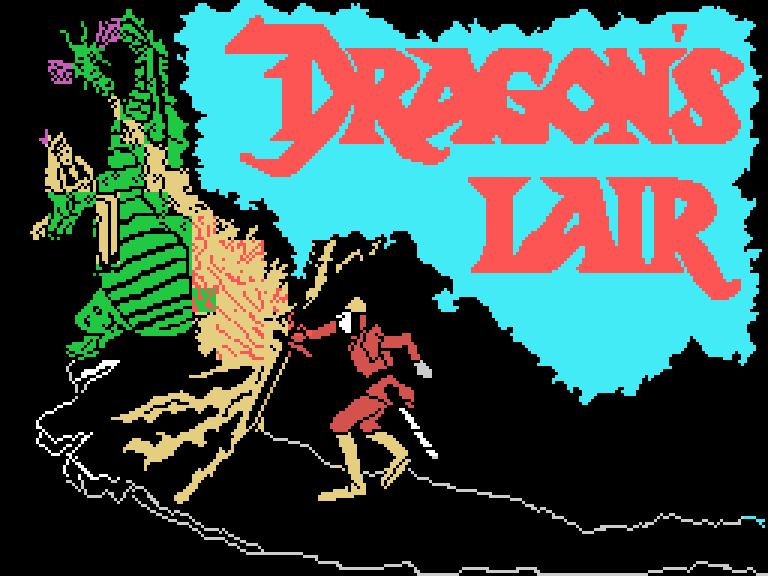
While checking a disc image of Dragon’s Lair for the Einstein 256, we noticed something odd about how the disc is numbered. It turned out to be a message, left for whoever managed to take the disc apart, with a challenge attached. As far as we can find, nobody has written about it before.
A Message Where the Numbers Should Be
An Einstein disc has ten sectors on each track, normally numbered 0 to 9. On this disc they are numbered with letters. Read in the right order, three positions apart around each track, the sector numbers of the first 25 tracks spell this:
Congratulations! Award yourself ONE Hacking-point! To achieve the PERFECT score you will find out: Who was pushed, Who won’t be nice any more, and the name of Glorfindel’s horse. Post your answers to the IMPLEMENTER (me). (The answers are on this disk!)
The remaining tracks start the message again.
It is not only a greeting. The game’s loader carries its own copy of the same text and uses it as its list of what to read: each letter is the number of the next sector to fetch. Copy the disc with ordinary sector numbers and the game will not load. The message is the copy protection.
Finding the Answers
Everything else on the disc is encrypted, and the key comes from an unusual place: the Z80’s refresh register, which changes with every instruction the processor fetches. Step through the loader in a debugger and the key comes out wrong. We let the loader run untouched in MAME, read the code it had decrypted, and rebuilt the cipher from that. Our version reproduces the game as it runs, byte for byte, apart from the variables the game changes as it goes.
With the cipher in hand, the three answers turned up in three different places. Two are in the game’s own memory once it is running. The third is better hidden: it sits in a first stage of the loader that is decrypted, run once, and encrypted again straight away, so it is only readable in memory for a moment.
The message is signed. After the decryption routine in the boot sector comes the name of its author, C. Lloyd-Parker, the “IMPLEMENTER” the answers were to be posted to. The disc carries no date; it is a build for the Einstein 256, so it is from the mid to late 1980s. We would love to hear from him.
Could It Have Been Found at the Time?
We used modern tools. The question that interested us afterwards was whether any of this was within reach in the 1980s, on an Einstein, with the software you could buy for it. It was, and our new guide walks through it with nothing but Xtal BASIC, the monitor built into the machine and Kuma’s ZEN assembler: Reading the Hidden Message in Dragon’s Lair, 1980s Style.
The Answers (Spoilers)
If you would like to look for them yourself, stop here. The disc image is in the library as Dragon’s Lair.
- Who was pushed? “Gollum was Pushed!”
- Who won’t be nice any more? “No more “Mister Nice Guy” - Morgoth.”
- The name of Glorfindel’s horse? “Noro-lim, noro-lim Asfaloth!”
All three are from Tolkien: Gollum at the Cracks of Doom, Morgoth from The Silmarillion, and Glorfindel’s cry to his horse Asfaloth in The Lord of the Rings.