The last sector of an original Tatung System Master is not empty. It holds the names of five of the people who built the machine, written there by somebody at Tatung and left for anyone who went looking. They have been sitting on the disc since 1984.
You do not need modern tools to read them. This guide does it on the Einstein itself, with the monitor built into the machine and a nine line Xtal BASIC program. It takes about two minutes.
Type DIR and you will not see anything unusual, because the names are not in a file. They sit in track 39, sector 9, the very last sector on the disc, in space that belongs to no file at all. DOS has no reason to go there and no way to show you if it did.
So the job splits in two. First get that sector into memory, which needs the monitor. Then read the memory, which BASIC does easily.
Nothing is written to the disc at any point. The monitor only reads.
Boot the System Master. At the 0: prompt, type:
MOSThat drops you into the machine's own monitor, which answers with MOS 1.2 and a > prompt. Now read the last sector into memory at address 8000 hex:
R 8000 81FF 0927 0Reading the R command from left to right: load into memory from 8000 to 81FF, read sector 09 of track 27 hex, which is track 39 in decimal, from drive 0. The two digit pairs are sector first, then track, which catches people out.
You can look at it here if you like, with T 8000 8077, which shows the bytes and their text beside them. The names are already readable. But the point of this guide is to do it from BASIC, so go back to DOS:
G FA03Start Xtal BASIC:
XBASBASIC loads low in memory and leaves the buffer at 8000 hex alone, so what the monitor read is still sitting there. 8000 hex is 32768 in decimal, which is the number BASIC wants. Type this in:
10 REM THE EINSTEIN TEAM
20 FOR R=0 TO 4
30 A=32768+R*24
40 N$=""
50 FOR I=0 TO 15
60 N$=N$+CHR$(PEEK(A+I))
70 NEXT I
80 PRINT N$
90 NEXT R
Then RUN.
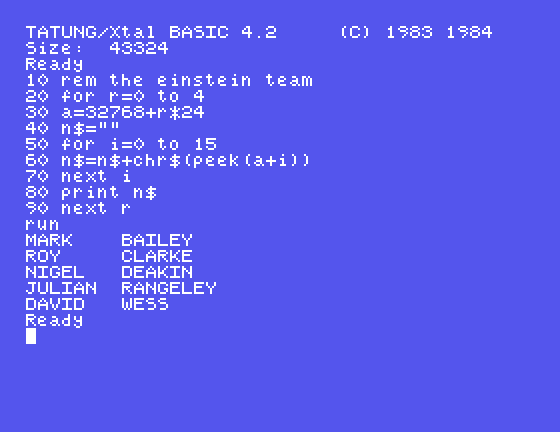
The names are laid out in fixed records of 24 bytes: eight for the forename, eight for the surname, and eight of spaces. Line 30 steps through them, R*24 at a time. Line 50 reads the first sixteen bytes of each record, the forename and surname, and skips the eight trailing spaces.
Five records fill 120 bytes, but the list stops a little sooner than that. Where a sixth record would have begun, at offset 70 hex, the sector turns to E5 and stays that way to the end of its 512 bytes. E5 is the byte an Einstein writes across empty space, so that filler is not padding anyone chose. It is simply where the list ran out. Change line 20 to FOR R=0 TO 5 and you will see it: the sixth line comes back as blocks and nonsense.
Original System Masters carry the names. So do a good many commercial discs, because a whole disc backup copies every sector whether a file owns it or not: the publisher backed up a master, wrote their own files over the top, and the last sector came along unnoticed. We have found the names on Castle Quest, on the Programmer's Kit and on ZEN, among others.
Not everything has them. A disc formatted from scratch will not, and nor will the XtalDOS image we have been serving for years. If your disc comes back as rows of E5, that is your answer: it is a copy made some other way.
Which System Master versions carry the names, and whether that could be used to tell an early master from a late one, is a question nobody has settled. If you try this on a dated master, we would like to hear what you find.
This is a rediscovery rather than a discovery, and we were thirty nine years late to it.
The March 1987 issue of Einstein User carries a letter on its problems page, under the heading The Secret’s Out!, asking whether there were any prizes for finding the names of Mark Bailey, Roy Clarke, Nigel Deakin, Julian Rangeley and David Wess on the last sector of the Einstein master disk. The reply printed underneath runs to four words, and it is from the man who answered that page as Dr Roy, whose own name is second on the list: “Congratulations; unfortunately no prize.”
So a reader worked all of this out at the time, on a real machine, with none of the modern tooling, and got nothing for it but the satisfaction of asking. The magazine printed his name and home town, as letters pages did then; we have left both out, since he did not write in expecting to end up on a website. How Pete Morris sent us looking in the first place, and what else is on that sector, is in Every Byte Was Sacred.
There is more hidden on Einstein discs than names. Reading the Hidden Message in Dragon's Lair uses the same monitor, plus Xtal BASIC and an assembler, to pull a message out of a game's copy protection.
This guide was checked on a System Master in MAME, with the commands exactly as printed. It has not been run on real hardware.