← Back to News
Novatryne: A New Shooter for the Einstein
A new vertical shooter for the Einstein, written from scratch in Z80 assembly: smooth movement on a chip with no scroll register, and no sprite flicker.
November 14, 2026

There is a new game for the Tatung Einstein. Novatryne is an arcade style vertical shooter, written from scratch in Z80 assembly, and it is the game the site's own Z80 assembly course was building towards. It is free to download, and you can play it in your browser right now.
New shooters for the Einstein have been rare: we know of no new vertical shooter for the machine in a very long time. Novatryne set out to show how far the Einstein can be pushed: every sprite the video chip will put on a line, all three channels of the sound chip, and tricks the video chip was never sold on. This article is about those tricks.
In 2045 a signal was detected in deep space. Its meaning was clear: Earth's destruction was coming. Earth's answer was NOVATRYNE, an orbiting fortress and foundry whose furnaces forge ships from enemy wreckage. Now they have arrived, and NOVATRYNE has chosen you to pilot its ships.
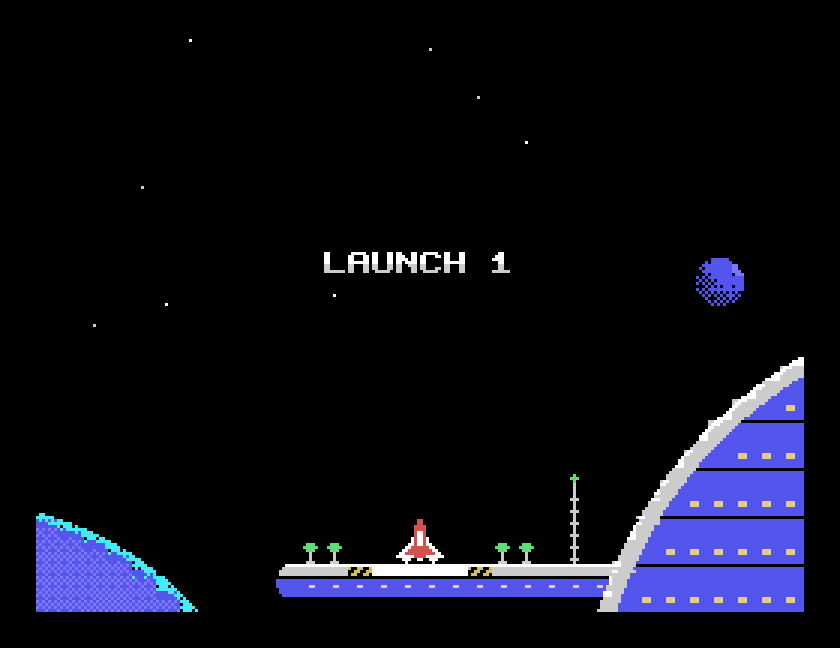
You launch from a docking arm on NOVATRYNE's hull and fight through six waves of the invasion, each of thirty attacks, with a mid-boss halfway and a boss at the end. Every wave brings a hazard of its own: a debris field, curtains of enemy fire, an asteroid belt, laser fences, a gravity well, and ships that cloak and vanish while still shooting at you. The last boss, a saucer mothership, has four turrets to destroy before its core will open.
Destroyed ships leave salvage, and between waves NOVATRYNE's upgrade bay turns it into weapons: faster fire, twin and triple guns, shields, missile strikes, EMP pulses, heavy bolts that punch through one ship into the next, and new hulls. You start with a single hull, so every one you buy counts. Your gun overheats if you hold the trigger, and from the third wave on, enemy ships break formation to dive at you.
The Einstein's video chip, a TMS9918A, has no scroll register. The background is a grid of tiles, each 8 pixels square, 32 across and 24 down, and moving something from one cell of the grid to the next makes it jump 8 pixels. A shooter needs things to glide down the screen a pixel or two at a time, fifty times a second, and the chip offers no help with that.
Novatryne's answer is to change the tile instead of moving it.

Keeping all of this in the background has a second purpose: it leaves the sprites free for the ships.
The video chip draws at most four sprites on any one scan line. A fifth on the same line is simply not drawn there. The usual way around that is to rotate which sprites are drawn from frame to frame, which makes them flicker. Novatryne does not flicker.
Every ship in the game, yours included, is two 16 by 16 sprites laid over each other, one for each colour, so two ships side by side fill a line. The game is built around that budget:
To check it, a bot played every wave while the sprite table was read as the game finished drawing each frame. Before these rules, between 1 and 5 per cent of frames had a line with more than four sprites. Now, on every wave, first attacks, last attacks and boss fights alike, none do.
A ship that simply slides sideways looks stiff, so Novatryne's ships bank. Your ship has five poses, from a hard roll left through level flight to a hard roll right, each its own pair of sprite patterns. When you move, the ship does not snap to the new pose: it eases one step towards it every three frames, so it rolls into a turn and levels out again after it. Every other four frames the game swaps in the same pose with a bigger engine flame, so the exhaust flickers as an engine should, even while the sprites themselves never do.
The enemies bank too. Each wave has four enemy designs, and every design has five banking poses of its own, so ships lean into the curves of the paths they fly. The accent colour changes from attack to attack, so one design can look like several different enemies.
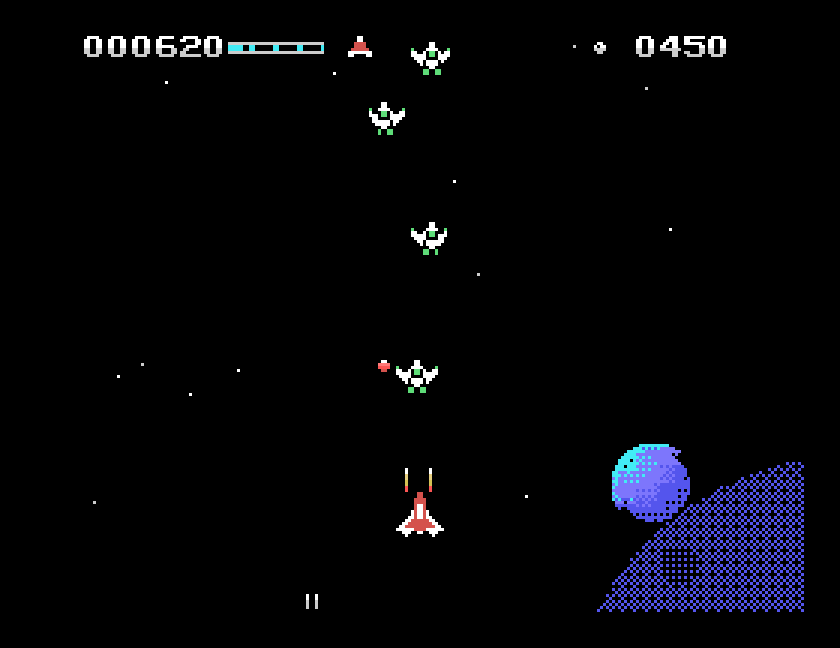
Colour does other work too. The cloaking ships of the last wave fade from grey to dark blue to black. Black on black space, they should vanish entirely, but they still hide the stars behind them, so what you see is a ship shaped patch where the stars go out. And they keep firing.
Novatryne needs no DOS. The Einstein's MOS loads the first track of the disc, and the game reads the rest itself with the MOS's own sector calls: a program of 21,292 bytes, then the title screen, the story, the upgrade bay and the music. Each wave's map, enemy designs and boss sit on two tracks of their own, read from the disc as you reach that wave. The data files are simply lists of blocks, each copied straight into video memory, or into RAM for the bosses.
There is no frame interrupt to lean on: on the Einstein none reaches the processor. Instead the game waits on the video chip's frame flag, fifty times a second, and everything, the stars, the ships, the shots and the music, moves to that beat.
Everything you hear is played on the three channels of the Einstein's AY sound chip. Besides the title tune there are seven long songs, all loaded into memory when the disc boots: one for every wave, and a fast, tense one for the bosses. The title music is dark and industrial, at 125 beats a minute, built bar by bar from its chords, a choice of four basslines and a choice of five drum patterns, with a falling tone for the kick and the chip's noise generator for the clanks and hi-hats.
Every enemy ship has its own random number generator, seeded from the wave, the attack and the ship. So every attempt at a wave plays out the same way, and its patterns can be learnt, as in the arcade shooters that inspired it.

Novatryne is free. Download the disc for MAME or for a real 3 inch disc, or play it in your browser with nothing to install. Fly with W, A, S and D, fire with SPACE, and press B for a missile strike and E for an EMP pulse once you have bought them. Joystick 1 works too, once you press its button.
So far Novatryne has been tested in MAME. If you run it on a real Einstein, we would like to hear how it goes.