Most of the disc images in this library arrived without a story. They were copied, passed around, uploaded to one archive and mirrored to another, and by the time they got here the person who made them was long out of the picture. This week one of them got its author back, and the disc had something to give him in return.
A Letter
Neil Murgatroyd taught himself BASIC on a VIC-20, moved to a Tatung Einstein in 1985, and wrote games on it: a cricket simulation from scratch, and football management games in the style of the ones other machines had and the Einstein did not. He sold the Einstein in the early nineties. Every so often over the next twenty years he searched the internet for his programs, and found nothing, until he found the Sports Compilation on this site: Run Out, Football Manager and Super Manager, on a disc labelled MicroBurger UK, 1987. He wrote to ask whether he could have the files separately, since the disc boots straight into a menu and XtalDOS’s DIR shows nothing at all.
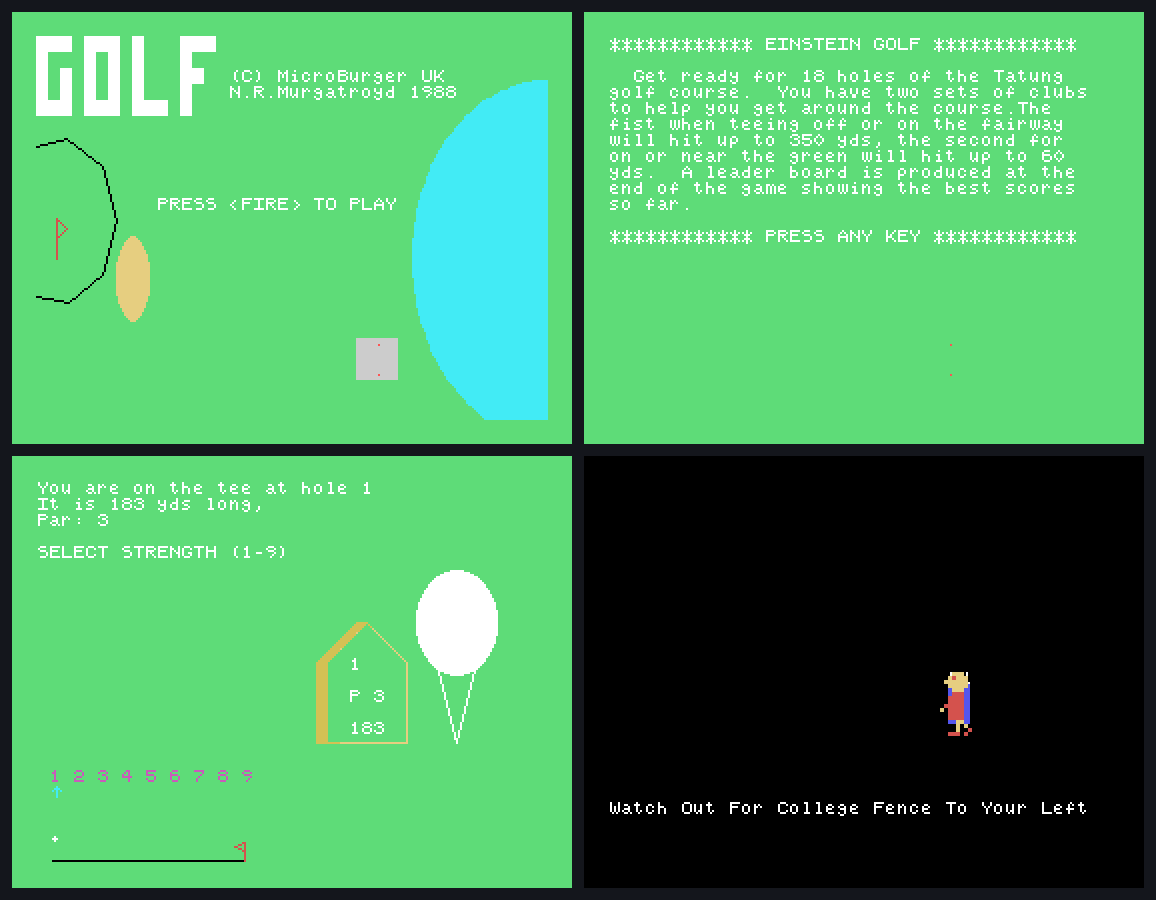
He also mentioned, in passing, that he had opened the image in Notepad and could make out “a simple golf game and some of my old snooker scores” in there somewhere. There is no golf game on the menu.
What DIR Does Not Say
The thirteen files on the disc are flagged as system files and read-only, which is why DIR keeps quiet about them. Twelve are XBAS programs and one is XBAS.COM, the Xtal BASIC interpreter itself. Pull them out and the compilation is bigger than its menu: behind Run Out, the animated run-out game, sits Ashley Metcalfe’s Cricket, a full limited-overs match simulation spread over seven programs that chain one into the next, with every county, both universities and the Test sides to choose from. Football Manager’s header reads “Neil Murgatroyd Feb87”.
But the directory of an Einstein disc, read as bytes rather than through DOS, has more in it than the live files. Deleting a file on this format sets one byte in the directory entry and leaves everything else alone: the name, the size, the list of blocks the data lives in, and the data itself, until some later file needs the space. On this disc there are eleven deleted entries beside the thirteen live ones, and nothing ever needed the space.
The Golf Game
One of them is GOLF.XBS. Its first lines read REM * GOLF SIMULATION * and REM *Neil Murgatroyd Feb87*: an eighteen-hole game with sprites, a yardage and par for every hole, and a word of advice on each tee (“Watch Out For Ditch 150 Yards Ahead”). Every block its entry points at was still unclaimed by any live file, so the file came back complete, 8,320 bytes and 356 lines of BASIC that decode cleanly from the first line to the last RETURN. Written the same month as his Football Manager, deleted from the compilation before it shipped, and sitting in the gaps of the disc for thirty-nine years.
The snooker scores were there too, nine deleted data files, though they are not scores: they are a snooker club’s 1988 subscriptions ledger, who had paid, who owed, who had been fined. They have names in them, so they are not going in the library. They have gone back to Neil, along with everything else: each program as a file, a plain-text listing of every one of them decoded with the keyword tables inside the disc’s own copy of XBAS, and the golf game.
One entry gave up only its name. RLGE2.XBS was deleted with no data blocks behind it at all, and the name is as much as survives. Neil also wrote a rugby league simulation.
Archaeology
This is the second time in a week that reading a disc image below the level of its directory has turned up something nobody knew was there. The Manic Miner master gave up a deleted Jet Set Willy and two unreleased builds; a home-made compilation has now given up a game its own author had forgotten. The method is the same in both cases and it is not clever: keep the whole image, read the directory yourself, check that a deleted file’s blocks have not been reused, and only then trust what comes out. What the two discs have in common is that nobody tidied them up. An image made by copying files would have kept the thirteen and dropped the rest.
We searched every image in the library for the rest of Neil’s work. He also wrote a more detailed cricket simulation and football and rugby league simulations of his own, and spent, in his words, many hours playing whole seasons of them. Nothing in the library carries his name, or MicroBurger’s, except this one disc. If you have an Einstein disc from the late 1980s with a cricket, football or rugby league game on it that you do not recognise, we would like to hear from you, and so would he.