module
42
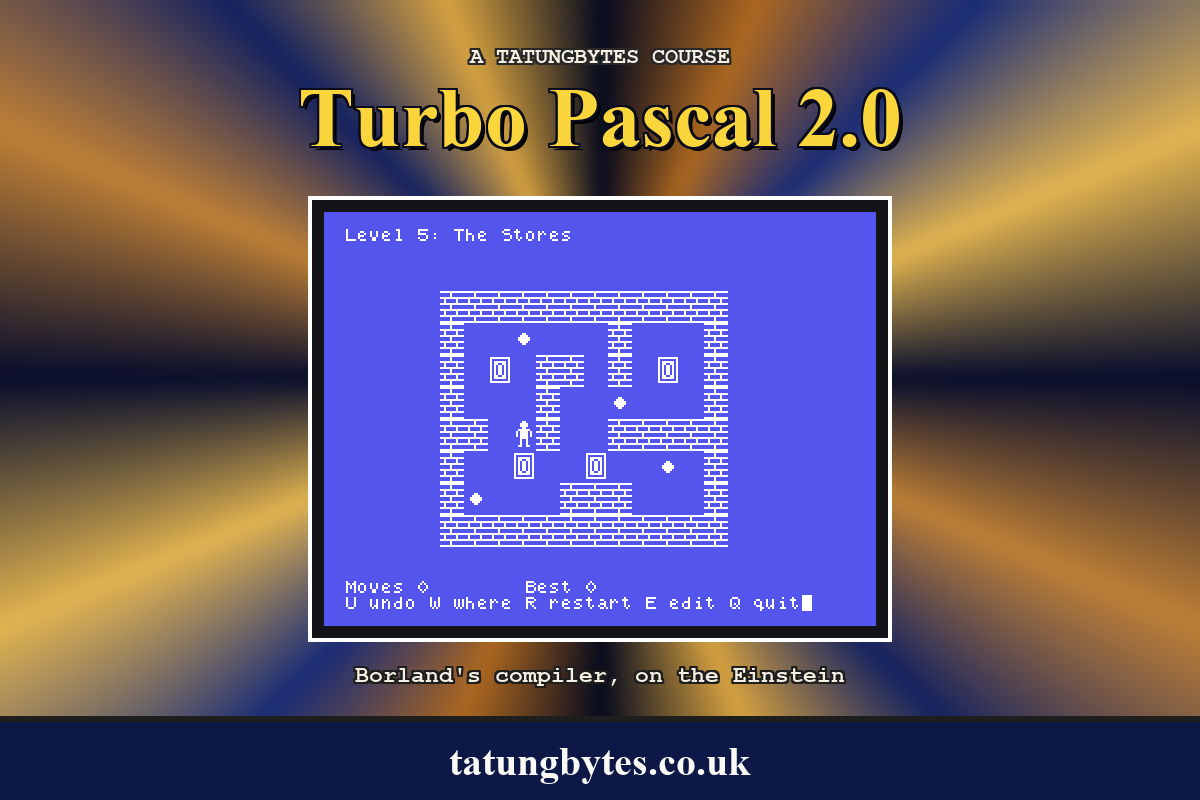
The course disc is the Turbo Pascal disc from the Downloads page, made smaller, set up for the Einstein, and with the finished game added.
| File | What it is |
|---|---|
TURBO.COM | Turbo Pascal 2.00A: the menu, the editor and the compiler |
TURBO.MSG, TURBOMSG.OVR | The error messages Turbo loads when you answer Y at the start. The manual and Borland's own notes each name one of these files for them |
TURBO.OVR | Part of Turbo's eXecute command, according to the manual |
WAREHOUS.COM | Warehouse, the game this course builds, finished. Type WAREHOUS at the 0: prompt to play it |
WAREHOUS.PAS | Its source - the program you will have written by the end of S36 |
MC.PAS, MC-MOD00.INC to MC-MOD05.INC | The source of MicroCalc, the small spreadsheet Borland wrote in Turbo Pascal and shipped with it (S38) |
Together they take 108k of the disc. The other 80k is yours.
The disc operating system underneath is the one the Turbo Pascal disc came with, and it signs on TATUNG/XtalDOS 1.31 DRC (C) 1985. It says No File every time it starts; take no notice.
WAREHOUS is the game exactly as S36 leaves it, with one difference: it keeps its levels and best scores in a file of its own, WAREHOUS.DAT, which it makes the first time you play. Your own game, from S31 on, uses LEVELS.DAT - so you can play the finished one as often as you like without its levels or its best scores getting in the way of yours.
Keys: the arrows move, U undoes, W shows where you can reach, R starts the level again, E edits it, Q quits.
Everything you save goes on the same disc: every program from the early sections, the ten stages of the game (WARE1 to WARE9, then WARE), LEVELS.DAT, the .COM files you compile, and a .BAK beside each file you save a second time. The game's stages alone take about 70k, because every file costs at least 2k and the later stages are several times that.
So keep an eye on Bytes Remaining, and clear away what you no longer need with ERA at the 0: prompt (S6) - old exercises, .BAK files, a stage once the next one works. Of what the disc came with, you need only Turbo and its message files, and MicroCalc's source for S38.
Turbo Pascal was sold for dozens of different computers, and it has to be told what the screen and keyboard of the one it is on can do. Borland supplied a program, TINST, to do the telling. The course disc's copy has been through TINST twice.
The screen. It is set up as EINSTEIN 40col., one of the choices TINST offers, with one change: that choice sends the Einstein a code that clears the screen, and it sends it every time a program finishes - so whatever the program printed vanished the moment it had printed it. The course disc's copy does not send it.
The DELETE key. On the Einstein, DELETE sends the same code as CONTROL and Y, and in Turbo as it came, that deleted the whole line the cursor was on. The course disc's copy has DELETE set to rub out the character before the cursor, which is what everyone expects of it.
Nothing else in Turbo Pascal is changed.
The Turbo Pascal disc from the Downloads page carries more, and was nearly full. These went, to make room for your work:
| File | What it is |
|---|---|
TINST.COM, TINST.DTA, TINST.MSG, TINSTMSG.OVR | The installation program and its data. Only needed to set Turbo up, which is done |
MC.COM, MC.HLP, MCDEMO.MCS | MicroCalc already compiled, its help text, and a sample sheet. You compile MicroCalc yourself from the source in S38. Without MC.HLP, MicroCalc's help is not available: press ENTER at its welcome |
TLIST.COM | A program for printing listings |
READ.ME | Borland's notes of April 1984, written for printing with TLIST |
AVE.PAS | An empty file |
-.02A | An empty file with a name like a label |
If you want any of them, they are on the Turbo Pascal disc on the Downloads page.
