module
19
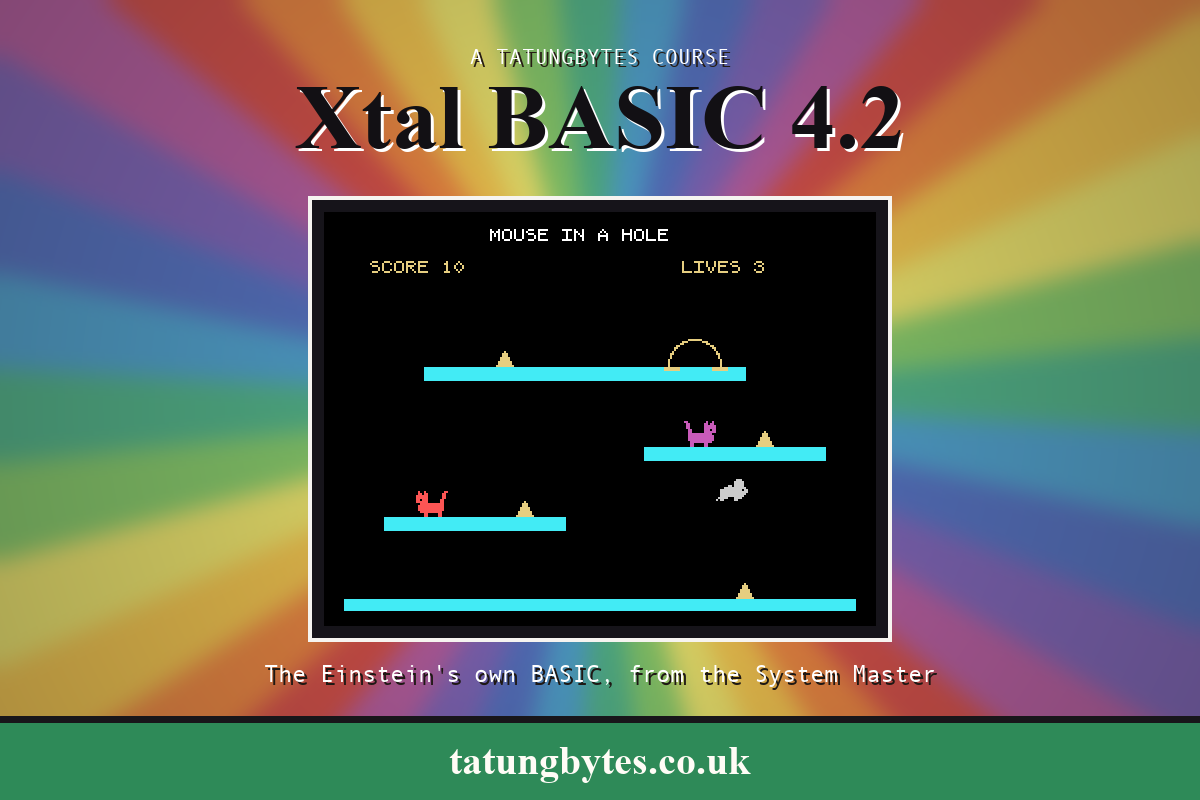
Lines will draw a platform. They will not draw a circle without a great deal of arithmetic, and they will not colour an area in at all.
This section is the rest of the drawing statements - and at the end of it the game has the thing the mouse is trying to reach.
ELLIPSE 128,96,40
draws an ellipse centred at 128,96 with a horizontal radius of 40.
Note ellipse, not circle. Left alone, the vertical radius is four thirds of the horizontal one - so that statement draws an oval, taller than it is wide. If you want a circle you have to say so, with a fourth number:
ELLIPSE 128,96,40,1
The fourth number is the ratio between the two radii. 1 makes them equal.
Two more numbers turn the ellipse into an arc: the angle to start at and the angle to stop at, in radians rather than degrees. A whole turn is about 6.28, so half a turn is about 3.14.
Angles start at 3 o'clock and go anticlockwise, so:
ELLIPSE 100,122,13,1,0,0,3.15
draws the top half of a circle - an arch. (The 0 before the angles is the line type from S18: 0 for a solid line. Get that wrong and put a 1 there and the arc will be drawn in erase mode, which is a confusing way to draw nothing at all.)
POLY 6,128,96,40,1
draws a regular six-sided figure inside the same circle - the arguments are the number of sides and then exactly what ELLIPSE takes. Three gives a triangle, and thirty is indistinguishable from a circle and takes about a third of a second.
POLY 0 asks for a nought-sided shape and gets you a Division Error, which is a fair answer.
FILL x,y
floods outwards from that point in the current GCOL colour, stopping wherever it meets a lit pixel. FILL x,y,c fills in colour c instead.
It is the quickest way to get a solid shape: draw the outline, fill the middle. The platforms in the listing below are drawn as four-sided outlines and then filled, which is shorter and clearer than the stack of lines S18 used.
Three things about FILL will bite you.
A gap lets it out. The fill stops at lit pixels, and a single-pixel hole in your outline is enough for it to escape through - and once out, it fills the entire screen. If a fill floods everything, the outline is not closed.
Starting on a lit pixel erases. If the point you give is already lit, FILL removes the connected lit region instead of colouring it - outline and all. So fill from a point you are sure is inside and empty, not from the edge.
Text stops it dead. Filling a region that has printed characters in it gives Stack Full Error and leaves the job half done. Keep fills away from the text rows.
And it is not fast: filling the whole screen takes nearly three seconds. Fill small areas, and do it while the reader is not watching.
10 BCOL 1
20 TCOL 15,1
30 CLS
40 PRINT @12,0;"MOUSE IN A HOLE"
50 TCOL 11,1
60 PRINT @2,2;"SCORE 0"
70 PRINT @28,2;"LIVES 3"
80 GCOL 7,1
90 FOR Y=0 TO 5
100 DRAW 0,Y TO 255,Y
110 NEXT Y
120 GOSUB 500
130 GOSUB 600
140 END
490 REM -- THE PLATFORMS --
500 FOR P=1 TO 3
510 READ X1,X2,PY
520 DRAW X1,PY TO X2,PY TO X2,PY+6 TO X1,PY+6 TO X1,PY
530 FILL X1+3,PY+3
540 NEXT P
550 RETURN
570 DATA 20,110,40,150,240,75,40,140,115
590 REM -- THE MOUSE HOLE --
600 HX=100:HY=122
610 GCOL 11,1
620 ELLIPSE HX,HY,13,1,0,0,3.15
630 DRAW HX-13,HY TO HX-13,HY-2
640 DRAW HX+13,HY TO HX+13,HY-2
650 RETURN
Starting from
LOAD "MOUSE2" from S18, or type it fresh.
What you should see
The same field as S18 but with solid platforms, and a yellow arch standing on the top one.
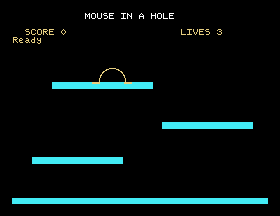
The hole is not filled, and that is the point: the screen behind it is black, so an outline is a hole. Filling it would give you a dome.
Save this. SAVE "MOUSE3".
645 FILL HX,HY+6,11 to fill the arch in. Does it still look like a hole?0,3.15 to 0,6.3. What do you get, and is it round? Now take the ,1 ratio out as well.FILL X1,PY - exactly on the corner of the outline. Run it. What happened to the platform, and which of the three warnings does that demonstrate?19.1 Draw a snowman: three circles of different sizes, one above another, each a true circle rather than an oval.
19.2 Draw a triangle, a square, a pentagon and a hexagon in a row across the screen with POLY, all the same size.
19.3 Draw a closed shape of your own and fill it. Then deliberately leave a one-pixel gap in the outline and fill it again, so that you have seen what that looks like once, on purpose.
Worked solutions are in Appendix II.
| Symptom | Cause |
|---|---|
| The fill covered the whole screen | The outline has a gap. Look closely at the corners. |
| The fill erased the shape | The starting point was already lit. Fill from somewhere inside and empty. |
Stack Full Error half way through a fill | There is text inside the area. Fills and text do not mix. |
| A circle came out as an oval | The vertical radius defaults to 4/3 of the horizontal. Add ,1. |
| An arc drew nothing | A line type of 1 erases. Solid is 0. |
Division Error | POLY 0. |
| The shape is the wrong way round | Angles are in radians, start at 3 o'clock and go anticlockwise. |
| Filling took ages | A big fill costs seconds. Keep them small, or do them before the player is watching. |
ELLIPSE x,y,r draws an oval - add ,1 for a circle - and two more numbers make it an arc, in radians from 3 o'clock. POLY n,... draws a regular polygon in the same space. FILL x,y floods from a point in the current colour and stops at lit pixels: leave no gaps, start from an empty pixel inside, and keep away from text.
S20, Reading The Screen Back - asking what is already drawn at a particular point, which is how the game will know the mouse is standing on something.
