module
9
A game needs words as well as numbers: a title, a name, a message when the cat gets you. BASIC keeps text in variables too, and they work almost exactly like the ones in S8 - with one mark on the end of the name to say which sort they are.
NAME$="MOUSE"
The $ is part of the name. NAME$ and NAME are two different variables and can both exist at once, one holding text and one a number.
Text goes in double quotes when you write it down, exactly as in PRINT.
An unset string variable is empty - not zero, not an error, just nothing at all. Printing one prints nothing.
The five-character rule from S8 applies here too, and so does the keyword trap: WORD$ has OR in it and is not a variable.
+ between two strings sticks them together:
PRINT NAME$+" HOLE"
gives MOUSE HOLE. That is the only arithmetic strings do - -, * and / on text are all errors.
A string holds at most 255 characters. Going past that is Str Ovfl Error, and the variable is left as it was.
PRINT LEN(NAME$)
gives 5. LEN of an empty string is 0.
Three functions, all counting from 1 for the first character:
LEFT$(A$,n) | the first n characters |
RIGHT$(A$,n) | the last n characters |
MID$(A$,p,n) | n characters starting at position p |
So with NAME$="MOUSE": LEFT$(NAME$,2) is MO, RIGHT$(NAME$,1) is E, and MID$(NAME$,2,3) is OUS.
Ask for more than there is and you get what there is - LEFT$("MOUSE",9) is MOUSE, not an error.
MID$ with two arguments, MID$(A$,p), gives everything from p to the end.
Every character has a code. ASC( gives you the code of the first character of a string, and CHR$( turns a code back into a character:
PRINT ASC("A");CHR$(65)
 65 A
You will want CHR$( later for the Einstein's own graphics characters, which have codes of their own.
"42" is text. 42 is a number. They are not interchangeable, and mixing them is a Type Error.
Two functions convert:
STR$(n) | the number as text, including the leading space PRINT would give it |
VAL(A$) | the number at the front of the text, or 0 if there is not one |
VAL("42")+1 is 43. VAL("HELLO") is 0 - no error, just 0, which is worth remembering when you start reading what somebody typed.
MUL$(A$,n) repeats a string:
PRINT MUL$("-",10)
draws a line of ten dashes. Useful for a title screen, and shorter than a loop.
10 NAME$="MOUSE"
20 PRINT "THE ";NAME$;" IS HERE"
30 PRINT LEN(NAME$)
40 PRINT NAME$+" HOLE"
50 PRINT LEFT$(NAME$,2)
60 PRINT MID$(NAME$,2,3)
70 PRINT RIGHT$(NAME$,1)
Starting from
Anything; RUN clears the variables first.
What you should see
RUN
THE MOUSE IS HERE
 5
MOUSE HOLE
MO
OUS
E
Ready
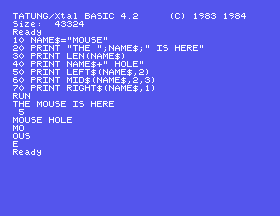
Notice line 20: the semicolons join the pieces with nothing between them, so the spaces you can see came from inside the quotes. And line 30's 5 has the leading space of a number, while none of the text lines do.
PRINT LEFT$(NAME$,9). The name is only five characters long. What do you get - an error, or something else?PRINT LEN(NAME$+" HOLE"). Does LEN count the space?80 PRINT NAME$+5 and run it. Read the error. Then make it work with STR$.9.1 Put your first name in one variable and your surname in another, and print them with a space between, then print how many letters there are in both together.
9.2 Print the first letter of a word on its own, then the last letter, without counting the letters yourself - use LEN.
9.3 MID$("MOUSETRAP",6,4) gives TRAP. Work out, before you run it, what MID$("MOUSETRAP",1,5) gives, and what RIGHT$("MOUSETRAP",4) gives.
Worked solutions are in Appendix II.
| Symptom | Cause |
|---|---|
Type Error | A string where a number belongs, or the other way round. STR$( and VAL( convert between them. |
| A string variable prints nothing | It has never been assigned - check the spelling, and the first five characters. |
Str Ovfl Error | The result would be over 255 characters. The variable is unchanged. |
VAL gives 0 for something that looks like a number | It reads from the front; if the front is not a number, you get 0 with no complaint. |
PRINT STR$(42) has a space in front of the 42 | STR$ gives exactly what PRINT would, and PRINT puts a space where a minus sign would go. |
Str Complex Error | Too many joins nested inside one another. Break the expression into two lines. |
A $ on the end of a name makes it hold text. + joins, LEN measures, LEFT$ RIGHT$ MID$ take pieces out counting from 1, ASC and CHR$ convert to and from character codes, and STR$ and VAL convert to and from numbers. Text and numbers never mix by accident - you get a Type Error instead.
S10, Asking A Question - getting something from whoever is at the keyboard, which is where a program stops being a fixed list of instructions.
