course · new for 2026
HiSoft Pascal Primer for the Tatung Einstein

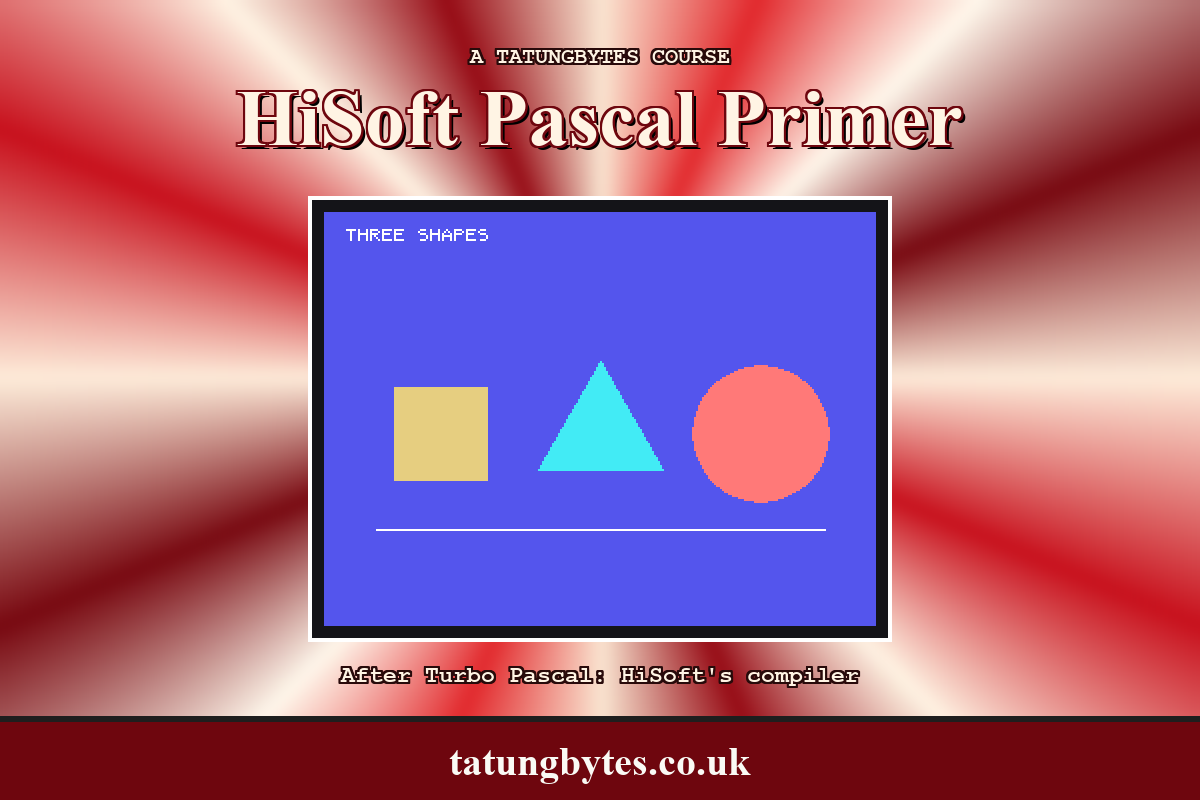
The Einstein had a second Pascal: HiSoft Pascal, HiSoft's compiler, published for the Einstein by Kuma with an "Einsoft Approved" label on its manual. Type HPEIN with a program's name at the DOS prompt and it signs on as Hisoft Pascal for the Tatung Einstein, Version of 24 October 1984 - no version number, only that date.
This is a primer, and it follows on from our Turbo Pascal course. It does not teach Pascal again. It takes someone who has finished the Turbo course through everything that is different in HiSoft Pascal, in the order the Turbo course met each thing - and then through the two things Turbo could not do at all: pictures and sound. If you have not done the Turbo course, start there.
You do not need to own an Einstein. Everything here runs on an emulator on your own computer, and everything you need is free.
Twenty sections and five appendices, with no game and no big project: each section is one difference, shown by a short program you type, compile and run. The first sections are the biggest change - HiSoft Pascal has no editor and no menu, so you type your Pascal into XBAS, the Einstein's own BASIC, as numbered lines, save it, and compile it from the DOS prompt, exactly as HiSoft's manual tells an owner to. Then the language: numbers and how they are written, names, text without a string type, reading the keyboard, CASE, recursion, types and arrays, files, and the heap. Then the machine: putting text anywhere on the screen, reading a key without waiting, chance, lines, circles and filled shapes on the graphics screen, notes from the sound chip, and machine code inside a Pascal program. An appendix puts the whole primer on one page: each thing from the Turbo course, and what HiSoft Pascal has instead.
Every section has the Turbo course's shape: an explanation, the code, what you should see, single changes to try - many of them "try it the Turbo way" - exercises with worked solutions, and the failures we actually hit.
What you set up for the Turbo course - MAME and the Einstein ROM - and the HiSoft Pascal Primer Disc from our Downloads page. It carries HiSoft Pascal, XBAS to type into, every program from the sections, and 120K of free space for your own work.
The same way as the other courses. Almost everything that can be read about HiSoft Pascal describes another machine's version, and almost everything about Pascal describes another product - and all of it is nearly right. So nothing here is taken from HiSoft Pascal on another computer, from a Pascal textbook, or from the manual alone without first running it on the machine. And because this primer is about differences, what it says about Turbo comes only from what the Turbo course established on the same machine.
That mattered. The Pascal words must be in capitals, and only the first eight letters of a name count. XBAS changes five characters wherever you type them - a question mark becomes the word PRINT, even inside quotes - and reads a line starting with a number as part of its line number. CTRL-C stops a running loop, which in Turbo it did only if you asked - and that check makes every loop about thirty times slower until you switch it off. ROUND(-2.5) is -2. There is no string, no Dispose, no Close and no GotoXY. And reading a file back loses the first three characters of every piece read from the disc - the primer shows the way round it. Every one of those is in the primer because the machine showed it to us.
Every listing, every change and every exercise solution was compiled and run before it was written down, and every listing was typed into XBAS and saved to make sure it survives the trip. The sounds were checked by recording the emulator's audio. What has not been done is a test on real hardware: the primer was written and checked entirely under emulation, and if you follow it on a real Einstein we would like to hear what differs.
HiSoft Pascal as it came is in the library as Hisoft Pascal, and its manual as HiSoft Pascal.
This primer was written with Claude Code, directed and tested by Gavin Watson. We say so openly because we think it is the right way to use these tools, and because you deserve to know how the thing you are learning from was built.
