Trevor Brownen describes himself as co-designer of the Einstein and founded Crystal Research, the Torquay company that wrote its DOS and its BASIC. His own website, xtal.info, carries twenty nine disc images with a note that they are copies of old discs with sector faults, some of them the same disc read more than once, “so it may be possible to put together complete disks”. One of them, a 183 KB file called EINMAST5, had six of its forty tracks missing altogether and bad sectors on nine more. It turned out to be the most interesting disc in the set, and it now boots.
What Was on It
The disc is a Crystal development disc, not a copy that was ever sold. Its system tracks hold XtalDOS 2.02, the 1986 version of the DOS, and its live files are the tools of a working day at Crystal: a Terminal program at version 0.1, a radio teletype reader, Cromemco’s DEBUG, a hex loader and sender, Disco Dan and Chuckie Egg.
The find is underneath. Deleted from the directory, but with their data still on the disc because nothing had been written over it, are the programs from the Einstein’s own master disc as they stood in April 1984, three months before the machine went on sale. Hangman at version seven by David Wess, dated 11 April 1984. Snakes at version eight by Nigel Deakin, dated 13 April. The analogue and digital clock by Mark Bailey at version 0.2, and Demo, Othello and the Einstein introduction at version 0.2 too. Each carries the line “Program subject to copyright” where the released versions carry Tatung’s name, and each differs from its release in roughly half its lines. Beside them is a deleted XBAS.COM that signs on as Xtal BASIC 5.00. Every other copy of Xtal BASIC 5 we have ever seen is 5.02.
So the disc was in use at Crystal from the spring of 1984 into 1986 at least, with the early master programs deleted along the way and the DOS updated underneath them. The machine’s system disc was being written on it while the machine was still being finished.
Putting It Back Together
The six missing tracks are gone for good, and with them one program, a file called OH, and the April 1984 versions of Picture Pen and the Einstein demonstration. Everything else survived, including the directory, which is why the deleted entries could be read at all.
We rebuilt the disc in three stages. First a faithful image, with the unread sectors marked bad so that the Einstein meets an error where the real disc had one. Then a recovery image with the eleven deleted entries whose data was all present restored to the directory, which takes a single byte each, and Disco Dan’s four bad sectors repaired from the copy already in our library, which turned out to be the same program shifted by 253 bytes. Then a working image with the one bad sector in Xtal BASIC 5.00 unflagged so the DOS will load it; we have no other copy of 5.00 to repair it from, so about 360 bytes of it are unverified.
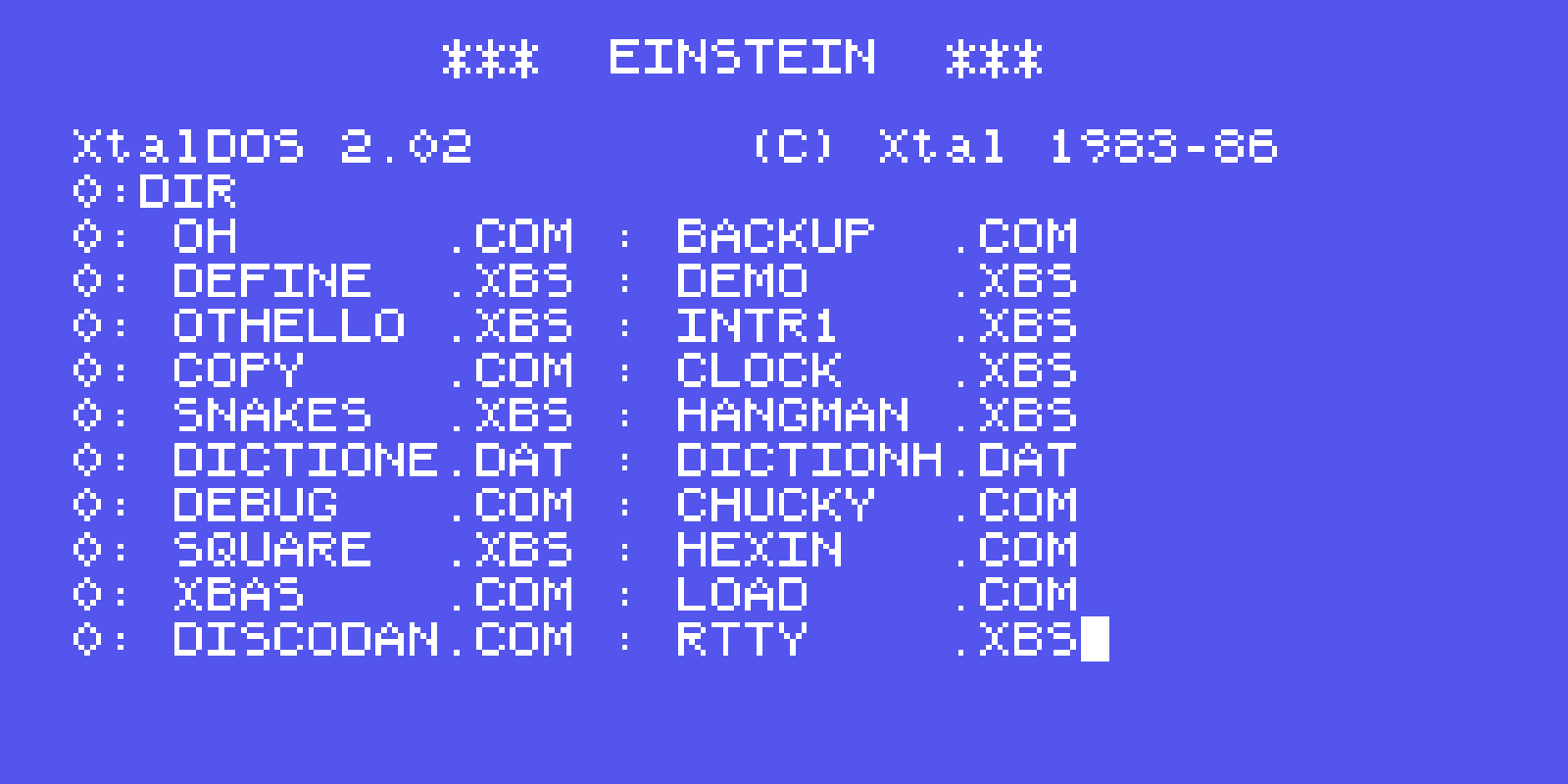
In MAME the recovery image cold boots to “XtalDOS 2.02 (C) Xtal 1983-86” and lists its 31 entries. Disco Dan shows its title, which adds two names to the credits we had for it, D. White and J. Line, with Gem Software. Xtal BASIC 5.00 signs on and adds two and two. And with a 1.31 master disc in drive 0 to supply a BASIC of the right age, the April 1984 Hangman shows its jailer’s speech, Snakes its two snakes, the clock its menu and Othello its instructions prompt. None of this has been tried on real hardware.
XtalDOS 1 and XtalDOS 2
The 2.02 on this disc is not itself new to us: a Super Draw disc in the library boots it, and four game discs carry it in their system tracks. But this is the first time we have had it on a disc of Crystal’s own, and it is a good moment to set out what separated the two generations of the Einstein’s DOS, because the magazines of the time were full of the question.
Who sold it. Both were written by the same people in Torquay. The 1.x versions sign on as “TATUNG/XtalDOS” and came with the machine: 1.11 on the earliest discs, 1.31 on the master disc most owners had. The 2.x versions drop Tatung’s name. XtalDOS 2.00 turns up on Solo Software’s game discs of 1984 and 1985; 2.02 and then 2.05 were sold by Crystal direct, as System 5, from September 1985. The earliest advertisement we know of offered “Xtal DOS 2.01 and Xtal Basic 5.00” for sixty nine pounds by mail order, the only mention of BASIC 5.00 in print we have found, and the version on this disc. The UK Einstein User Group reviewed System 5 in February 1986 as “a new DOS, under seventy pounds”, and The Brain’s reviewer wrote of catching the next train to Torquay to congratulate Trevor Brownen and his co-directors. By 1998 it was still on sale from B & H at around twenty nine pounds, because, as one editor put it, “it only comes with System 5”, and both 2.02 and 2.05 were in circulation.
Why people bought it. Drives. DOS 1.31 assumes that every drive is a 3 inch, 40 track, single sided unit like the one in the machine. DOS 2 knows about double sided and 80 track drives, in 3.5 inch and 5.25 inch sizes, and lets each of four drives be set separately: an Epson 40 track double sided drive gave 370K, a 3.5 inch drive 760K or more, against 190K on the built in drive. The user group’s 1986 article on discs said it plainly: double sided or 80 track drives need System 5, or the new DOS that Tatung had promised. Tatung’s answer, when it came, was DOS 80, a cheaper rival at about ten to fifteen pounds, which one later editor called “a hastily written clone of XtalDos 2”.
What it cost in return. DOS 2 is bigger. DOS 1.11 and 1.31 start at EC00 hex; DOS 2.02 starts at EA00, 512 bytes lower, and the boot code jumps to a different address. Some software noticed. A member wrote in 1986 that WDPro and The Cracker failed under the new DOS, and that the Einstein WordStar “will not even load properly under DOS 2.02”. In 1987 Cecil Wallis found that DOS 2.05 had changed the disc parameter block and so broke the silicon disc, and printed a patch. As late as 1990 a Bedfordshire member who had bought 2.02 at a show found it crashed Tasword, and was told that Tasword “only really likes standard 1.31 DOS”.
What came with it. System 5 was a package, not just a DOS: Xtal BASIC 5, which gained a compiler in 1987, the XSM assembler, the XED screen editor, an autorun generator, and new Backup and Copy programs. The 2.x discs also carry a command in their boot sector that runs at power on, which is how Boardello and a WordStar disc in the same batch start themselves. And every 2.05 disc carries a three byte serial stamp in its DOS and inside every Crystal program on it, so no two copies hash the same. The 1.31 master discs have a secret of their own, the five programmers’ names in their last sector, which the 2.x discs do not; our guide Reading the Hidden Names on Your System Master shows where to look. Two of those five names, David Wess and Nigel Deakin, are on the April 1984 programs here, two years before anyone hid them.
Where to Get It, and Whose It Is
The rebuilt disc is in the library as XtalDOS 2.02 Development Disc: the faithful image, the recovery image and the working image, with a note on what was changed in each. The original images are on Mr Brownen’s own site, published under the GNU General Public Licence; the programs themselves remain the copyright of Crystal Research, Tatung and their authors, and are hosted here with that credit. Our thanks to Trevor Brownen for putting the discs online, and for the note that made us try.