There is a new name on the site. L. Boffin has been writing small programs for old machines since the ZX81 days, and his latest is for ours: 1D Life, in the library now as a self booting disc.
Life, on One Line at a Time
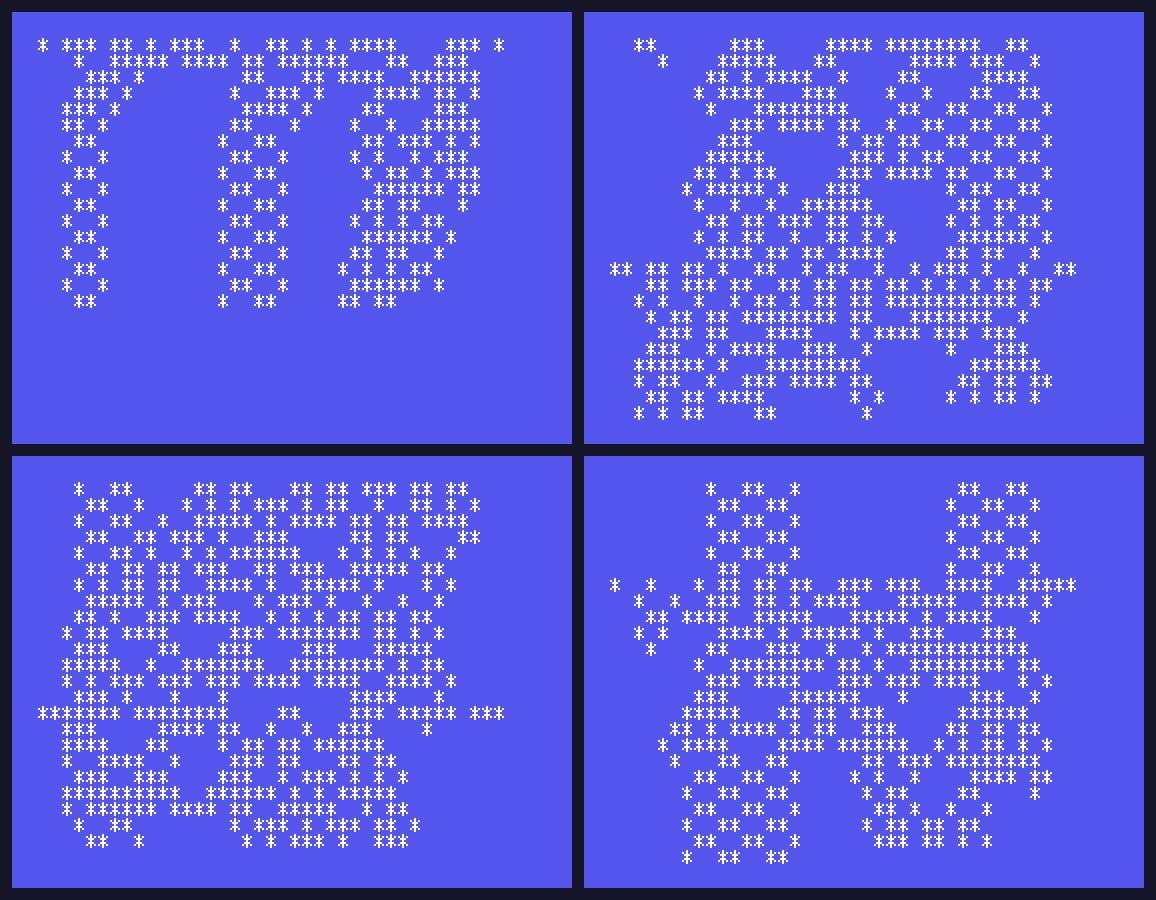
Conway's Game of Life is usually a grid. This is its one dimensional cousin, and on a text screen it is arguably the better show. Every generation is a single line of asterisks, and the screen scrolls, so what you watch is not a board but a history: a random row of thirty nine cells at the top, and below it, line by line, what became of them.
The rules are as short as the display. Each cell counts the four cells around it, two either side. A living cell with two or four living neighbours survives, and dies of loneliness or overcrowding with any other number. An empty cell with two or three neighbours has new life born into it. That is all, and out of it come genuinely life like structures: colonies that spread outwards, braid around each other, knit into arches, and then thin out and die away. After about twenty generations the thing has usually reached a dead end, so the program tosses it out, makes a fresh random row, and starts again.
From the Centurion to the Einstein
The rules and the original program are Nakazoto's, written in BASIC for the Centurion minicomputer. L. Boffin saw the video, and as he puts it, it reignited his retro programming enthusiasm. He wrote his own version in 6502 assembly for the BBC Micro first, far and away the largest 6502 program he had written, and then went looking for another machine to put it on.
That turned out to be the Einstein, and in C rather than assembly. Writing C on the machine itself means Hisoft C, a real keyboard and a lot of patience, so he went the other way: the z88dk cross compiler on a PC, our Einstein Disc Tools to write the compiled program onto a disc image and make it autoboot, and MAME set up the way our MAME guide describes it. Edit, run one batch file, and the Einstein boots with your program running.
The Part That Matters More Than the Game
His GitHub repository is not really a game release. It is a walkthrough of that whole route, written for someone who has never built anything for the Einstein, with 1D Life used as the worked example instead of Hello World. Every line of the batch file is explained. As far as we know it is the shortest way in for anyone who fancies writing something for the Einstein in C, and we would like to see more of them.
It is also worth saying what he is not short of. His public code goes back to 2016 and takes in BCPL on the BBC Micro, a pair of 1K games for the ZX81, a text adventure written in C on a BBC Master, a tool for building Beeb adventures on a PC, and a game for the micro:bit. The Einstein is a recent addition to that list, keyboard faults and all.
The disc is a 210K DSK, ready for MAME or a real machine. Press a key when it asks, which is how it seeds its random number generator, and then leave it running.