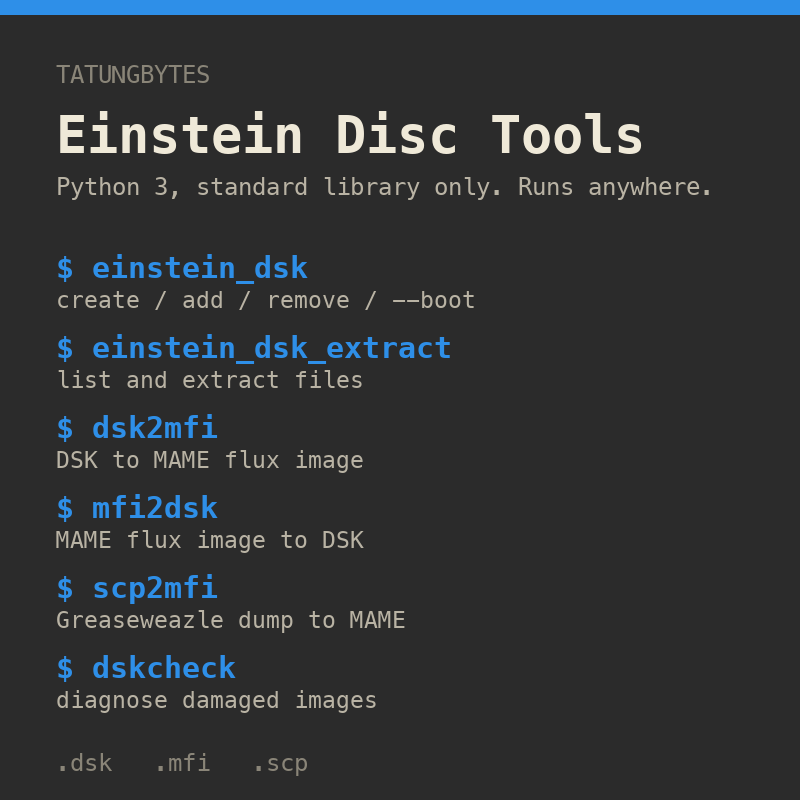
For years the only way to put a file onto an Einstein disc image, or get one off, was a tool from the nineties that runs on an old version of Windows. Many of us have kept a spare PC or a virtual machine alive for nothing else. That ends with Einstein Disc Tools, a set of six small Python 3 scripts that need nothing beyond Python itself and run wherever it does.
What They Do
Create a blank .dsk and add files or whole folders to it. Make a disc boot straight into a program at power on, no DOS required. List and extract the files on any Einstein disc image. Convert a .dsk to MAME's .mfi flux format and back, which matters because MAME keeps what a DOS session writes to an .mfi but silently throws away writes to a .dsk. Turn a Greaseweazle or SuperCard Pro dump of a real disc into an image MAME can boot. And check any image for damage, down to which bytes of which files sit on unreadable sectors.
How They Were Built
The interesting part is the method, which is the same one behind the site's Z80 Assembly Course. The Einstein's disc format was never well documented and the surviving sources disagree with each other. So instead of trusting any of them, every claim about the format was tested by running a live Einstein in MAME: format a blank disc, write a file with known contents, read the image back byte by byte, and confirm what a real DOS actually did. Sixteen numbered experiments stand behind the release, and each confirmed fact went into the reference that Claude Code works from before any tool was written. The result is a set of tools where every behaviour was checked against real discs rather than assumed.
Already on Version 1.2
Within a day of release the scripts were run against real flux dumps with deliberately planted damage, and three of them improved as a result. The download page carries release notes, and the full changelog ships inside the zip. If a disc image refuses to open, run dskcheck on it and send us the output through the Contact page.