module
19
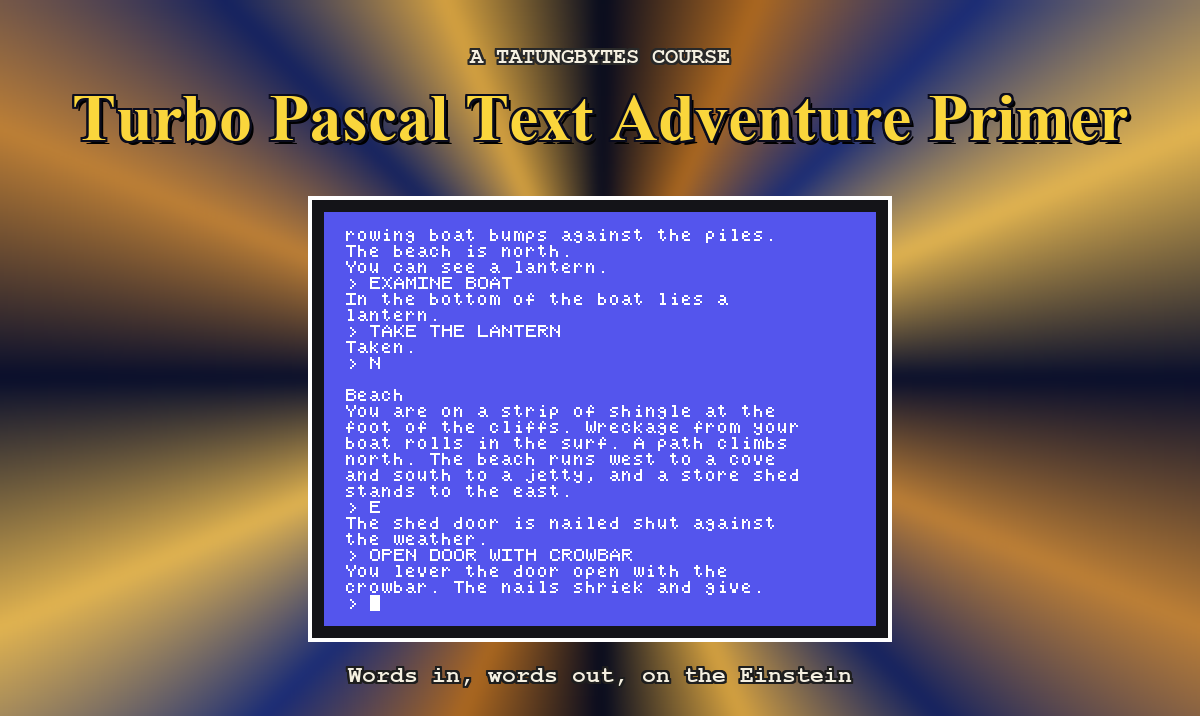
An adventure is more than rooms: there are things to find, and the player's pockets to put them in. BEACON has six that can be carried: a crowbar, a lantern, an oil can, the keeper's logbook, a box of matches and an iron key. This section puts them in the world and lets the player pick them up.
Thing = record
  Name: Str20;
  Place: Integer;
end;
Name is what the game prints: a crowbar, the logbook. Place is where it is: a room number, or 0 for carried. In S20, -1 will mean "hidden". Six of them make Obj, and Start gives each its name and place when the game begins.
Their numbers line up with their nouns: thing 1, the crowbar, is noun token 20; thing 6, the key, is 25. So the thing a noun means is N1 - 19, and a noun outside 1 to 6 (DOOR, LAMP) is not something you can carry.
Carried(T) asks whether thing T is held: its place is 0. Near(T) asks whether it is held or in this room: the test for anything the player uses.
Look now ends by listing what is in the room: You can see a crowbar.INVENTORY, or I, lists what is carried, or nothing.TAKE checks the noun is a thing, not already carried, and here, then sets its place to 0. DROP sets it to the room.EXAMINE and READ (the same procedure) show the logbook's message, the boat's and the ship's when they are there, and otherwise You see nothing special.And one rule in the main program: the verbs from TAKE to READ, tokens 10 to 17, need a noun. Without one, the game asks: What do you want to TAKE?
The const part gains Things = 6;, the type part gains Str20 = string[20]; and the Thing record above, and the variables gain Obj: array[1..Things] of Thing;.
After Load, add Start:
procedure Start;
begin
  Obj[1].Name := 'a crowbar';
  Obj[1].Place := 2;
  Obj[2].Name := 'a lantern';
  Obj[2].Place := 3;
  Obj[3].Name := 'an oil can';
  Obj[3].Place := 4;
  Obj[4].Name := 'the logbook';
  Obj[4].Place := 6;
  Obj[5].Name := 'a box of matches';
  Obj[5].Place := 7;
  Obj[6].Name := 'an iron key';
  Obj[6].Place := 8;
  Here := 1;
  Quit := False;
end;
After Parse, add:
function Carried(T: Integer): Boolean;
begin
  Carried := Obj[T].Place = 0;
end;

function Near(T: Integer): Boolean;
begin
  Near := (Obj[T].Place = 0) or
          (Obj[T].Place = Here);
end;
Look becomes:
procedure Look;
var
  T: Integer;
begin
  Writeln;
  Writeln(Map[Here].Name);
  Say(Here);
  for T := 1 to Things do
    if Obj[T].Place = Here then
      Writeln('You can see ', Obj[T].Name,
              '.');
end;
After Walk, add:
procedure Inventory;
var
  T: Integer;
  Any: Boolean;
begin
  Any := False;
  Writeln('You are carrying:');
  for T := 1 to Things do
    if Carried(T) then
    begin
      Writeln('  ', Obj[T].Name);
      Any := True;
    end;
  if not Any then
    Writeln('  nothing.');
end;

procedure Take;
var
  T: Integer;
begin
  T := N1 - 19;
  if (T < 1) or (T > Things) then
    Writeln('You can''t take that.')
  else if Carried(T) then
    Writeln('You already have it.')
  else if Obj[T].Place <> Here then
    Writeln('It isn''t here.')
  else
  begin
    Obj[T].Place := 0;
    Writeln('Taken.');
  end;
end;

procedure Drop;
var
  T: Integer;
begin
  T := N1 - 19;
  if (T < 1) or (T > Things) then
    Writeln('You can''t drop that.')
  else if not Carried(T) then
    Writeln('You haven''t got it.')
  else
  begin
    Obj[T].Place := Here;
    Writeln('Dropped.');
  end;
end;

procedure Examine;
begin
  if (N1 = 23) and Near(4) then
    Say(14)
  else if (N1 = 30) and (Here = 3) then
    Say(26)
  else if (N1 = 31) and (Here = 12) then
    Say(27)
  else
    Writeln('You see nothing special.');
end;
Act becomes:
procedure Act;
begin
  case V of
    1..6: Walk(V);
    7: if (N1 > 0) or (P > 0) then
         Writeln('Which way?')
       else
         Writeln('Go where?');
    8: Look;
    9: Inventory;
    10: Take;
    11: Drop;
    12, 17: Examine;
    18: Quit := True;
  else
    Writeln('You can''t do that yet.');
  end;
end;
And the main program:
begin
  Load;
  Start;
  Writeln('BEACON');
  Look;
  repeat
    Write('> ');
    GetLine(Line);
    if Parse(Line) then
      if V = 0 then
        Writeln('There is no verb in that.')
      else if (V in [10..17]) and
              (N1 = 0) then
        Writeln('What do you want to ',
                Line, '?')
      else
        Act;
  until Quit;
  Close(Msg);
end.
For now the matches lie in the kitchen and the key in the bedroom, in plain sight. S20 hides them.
Starting from
BEACON2, read into a new work file BEACON3. Save before you run.
What you should see
> I
You are carrying:
  nothing.
> W
Cove
...
You can see a crowbar.
> TAKE CROWBAR
Taken.
> TAKE CROWBAR
You already have it.
> TAKE
What do you want to TAKE?
and in the front room, EXAMINE LOGBOOK prints the keeper's log.
Start, change the lantern's place from 3 to 0. What does I say when the game begins?Take, take out Obj[T].Place := 0;. Take the crowbar, then look at I. What has gone wrong?[10..17] to [11..17]. What does TAKE alone say now, and why?19.1 Let the player carry no more than four things: You can't carry any more.
19.2 Make DROP say what was dropped: You drop a crowbar.
19.3 Make EXAMINE say what any thing is when it is near: It is a lantern.
Worked solutions are in Appendix II.
Each thing is a record of a name and a place: a room, or 0 for carried. Its noun's token, less 19, is its number. TAKE, DROP, INVENTORY and EXAMINE are a few lines each, and verbs that need a noun ask for one.
S20, Locks, Lamps And Logbooks: the puzzles.
This form is protected by reCAPTCHA, and the Google Privacy Policy and Terms of Service apply.
