module
21
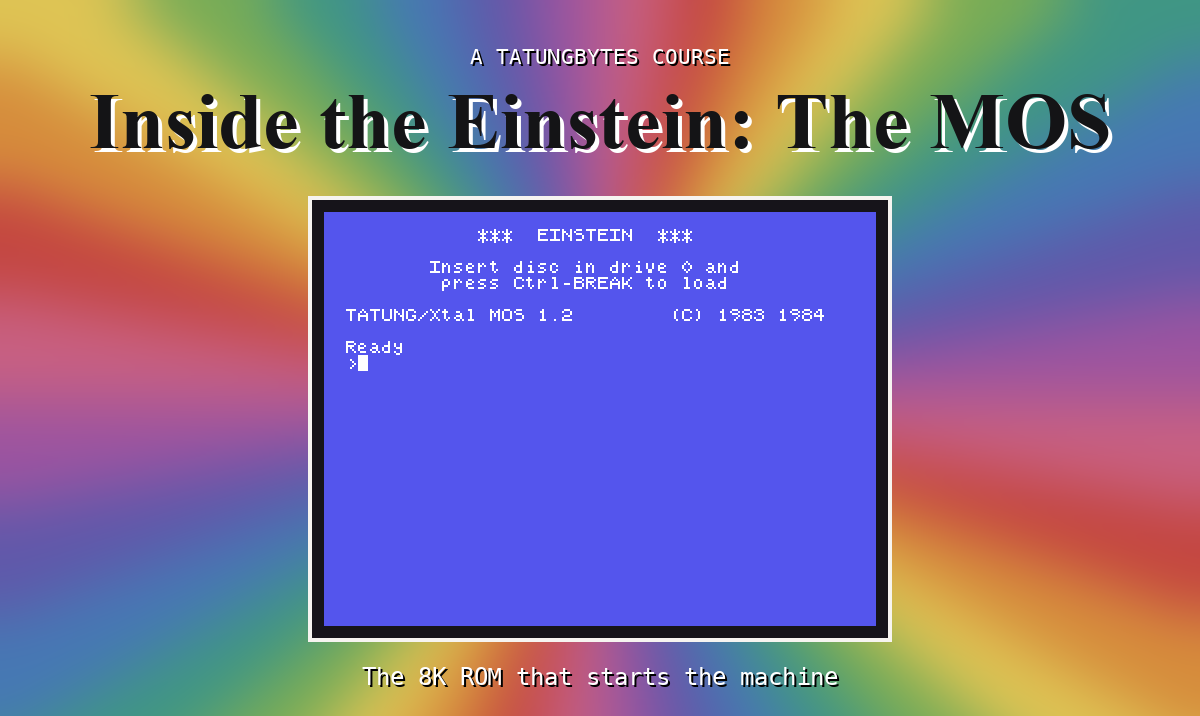
Everything in this course runs your ROM in MAME. A real Einstein reads its MOS from a chip on the main board, so running your own MOS on one means putting your 8,192-byte image into a chip of the same kind and fitting it in place of the original. Owners did something like it in 1985: Tatung sold a replacement ROM, for £11.90, to owners whose start-up screen still said version 1.1, and fitting it meant swapping the chip.
This appendix explains what is involved. It is optional, and it means opening the machine: if you are not comfortable working on old electronics, stay with MAME.
The MOS lives in socket I023 on the main board - the name MAME's file, mos12.i023, comes from. It is a 2764: a 28-pin EPROM holding 8K bytes, in a socket, with a quartz window on top (usually under a label). Einsteins have been seen with a Fujitsu MBM2764 and a TI TMS2764 there. Beside it, I024 is a second, empty 28-pin socket.
An EPROM is a ROM you can write yourself with the right equipment, and erase with ultraviolet light through that window.
A chip. Use a 27C64, the later CMOS version of the 2764 - same size, same 28 pins, same 8K. New-old-stock and pulled 27C64s are easy to find and cheap. Their great advantage is the programming voltage: a 27C64 is written at about 12.5 V, while many original 2764s need 21 V, which most modern programmers cannot supply. Any speed grade is fast enough; the Einstein's own chips were 300 ns and 450 ns parts.
A programmer. A USB "universal programmer" writes the chip from your PC:
| Programmer | Notes |
|---|---|
| XGecu TL866II Plus | The common hobbyist choice. Programs 27C64s. Its programming voltage tops out at 18 V, so it can read but not write 21 V parts. |
| XGecu T48 | Its successor, with a higher programming voltage; check its current device list for the exact chip you buy. |
Both come with their own Windows software; the open-source minipro tool drives them from macOS and Linux.
An eraser - a small UV lamp box sold for the purpose - if you want to reuse chips. A 27C64 needs roughly 15 to 20 minutes under a proper eraser; give a weaker one longer, and always check the chip reads blank (all FFh) before you program it. Daylight and room lighting erase EPROMs only very slowly, but they do: cover the window with a label once the chip is programmed.
An IC extraction tool, or a small flat screwdriver used with care, and an anti-static wrist strap or a habit of touching earthed metal first.
mos12.i023, choosing the exact chip type in the programmer's software, and let the software verify it.If the screen stays blank, switch off and check, in order: the chip is the right way round, no pin is bent under, the image was programmed and verified, and the image is 8,192 bytes from a source that built cleanly. Then put the original back and compare.
You do not need a real Einstein to use anything in this course. A MOS that works in MAME with your own einstein.zip is the same 8,192 bytes you would program into the chip - so the emulator is also the safest place to test an image before you burn it.
This form is protected by reCAPTCHA, and the Google Privacy Policy and Terms of Service apply.
