module
16

S15 took lists apart. Going the other way - building one up - is what lets a procedure answer a question with several things rather than one.
?show fput "red [green blue]
[red green blue]
?show lput "blue [red green]
[red green blue]
?show se [red green] [blue]
[red green blue]
fput - first put - puts one thing on the front. lput - last put - puts
one on the end. se - sentence - takes two lists and runs them together
into one.
The difference between lput and se is worth being clear about: lput adds
an item, se joins two lists. Give lput a list and the whole list
goes in as one item:
?show lput [c d] [a b]
[a b [c d]]
?show se [a b] [c d]
[a b c d]
A list inside a list is a perfectly good thing to have, and occasionally what
you want. It is rarely what you meant when you reached for lput.
None of them changes what you gave them. They hand back something new, exactly
as bf and bl did.
Put fput together with the recursion from S14 and a procedure can build a list
as it goes:
to countdown :n
if :n < 1 [op []]
op fput :n countdown :n - 1
end
If there is nothing left to count, hand back an empty list. Otherwise hand back this number, with the rest of the countdown after it.
That is a procedure whose answer is a list, not a number - op will hand
back either. Each call adds one item to the front of whatever the calls beneath
it produced, so the list assembles itself from the inside out.
< is the other way round from the > in S14: less than. There is also =.
to countdown :n
if :n < 1 [op []]
op fput :n countdown :n - 1
end
show countdown 5
Starting from
A fresh boot, at the ? prompt. The minus sign is SHIFT and the = key -
the key marked - gives an underscore and Dr Logo will not know what to do with
it.
What you should see
countdown defined
[5 4 3 2 1]
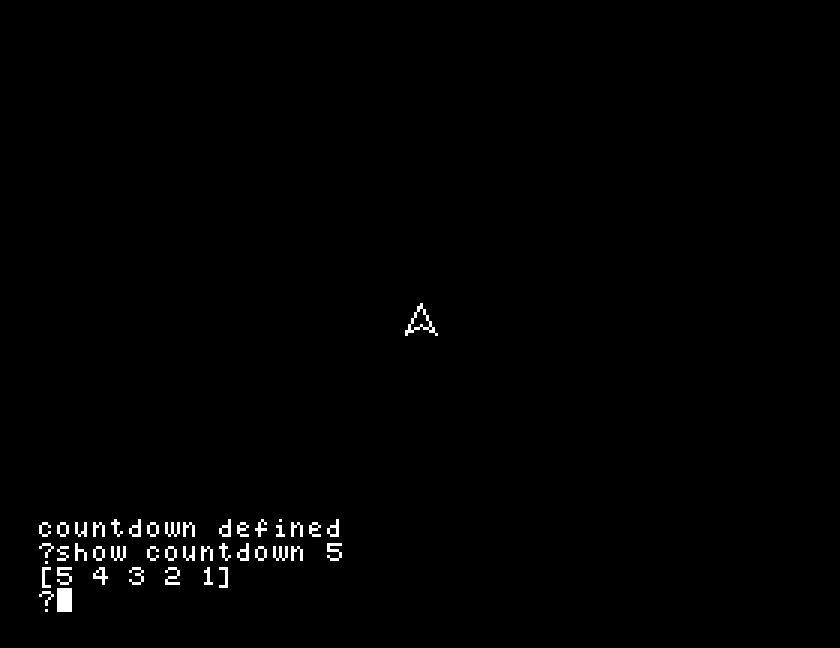
The brackets are there because show keeps them. That matters here: it is how
you can tell you have been given one list of five things rather than five
separate answers.
fput to lput. The numbers come out in the other order. Work out why
before you run it - think about which end each call is adding to.show to pr. The same list, printed differently. Which of the two
would you use to check that a procedure really did hand back a list?countdown a name that is already a primitive - to count :n - and see
what happens. Then try show count 5 anyway. What did Dr Logo run instead,
and what did it say?| Symptom | Cause |
|---|---|
Out of LOGO stack space |
The recursion never stops. Usually the input is not getting smaller - check the minus sign is SHIFT and =. |
I don't know how to _ |
The key marked - again. |
[... ] didn't output to show |
The thing you called does not hand a value back. If you meant a procedure of your own, check the name is not already a primitive. |
| A list inside your list | lput adds an item. To join two lists use se. |
| The order is back to front | fput adds to the front, lput to the end. |
fput adds to the front of a list, lput to the end, and se joins two lists
into one. A procedure can hand back a list with op, and a recursive one can
build a list up as it goes.
S17, remembering things - giving a name to a value so you do not have to pass it along every time.
