module
1
Most programming languages are built for people who are already programmers. Logo was built for children, by people who thought that teaching a machine to do something is the best way to find out whether you understand it yourself.
That makes it an unusually good language to meet a small computer through. You will not spend the first three sections setting up a project. You type a line, and something happens.
It is not for making logos. The name is from the Greek logos - word, thought, reason - and the language was written in 1967 at Bolt, Beranek and Newman by Wally Feurzeig, Seymour Papert and Cynthia Solomon, as a way of teaching thinking rather than programming.
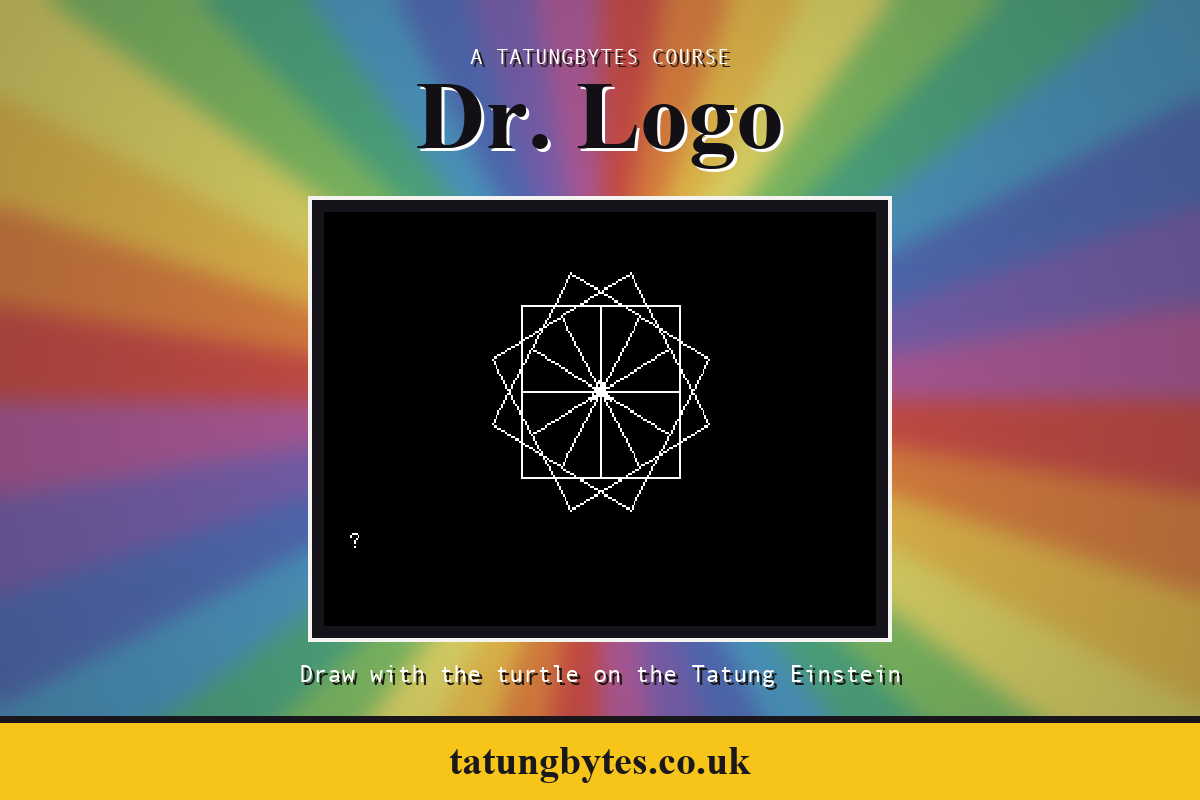
Its famous trick is the turtle: a pointer on the screen that you steer with instructions like "forward fifty" and "right ninety", leaving a line behind it. Drawing is immediate, visible, and hard to be wrong about in a way you cannot see - which is exactly what a beginner needs.
But the turtle is the shop window, not the shop. Underneath, Dr Logo is a language about words and lists, and by the end of this course you will be using it for things that have nothing to do with drawing.
Dr Logo itself was written by Digital Research and is dated 1983. The version on the Einstein announces itself as version 1.20.
The Tatung Einstein is a British computer, built around the Zilog Z80 processor, sold from 1984. Its graphics screen is 256 pixels across and 192 down, and when the turtle takes one step it moves exactly one of those pixels. That is a small screen by any modern measure, and small enough that you can reason about every line you put on it.
You do not need to own one. The course runs on an emulator, and everything you need is free.
This course is a collection of small programs, not one big one.
Each section takes one thing the machine can do, explains it, and gives you a short program that shows it working. The programs stand on their own: you can run any of them from a cold start without having typed in anything from an earlier section.
That is deliberate. Logo rewards small pieces that fit together, and a course that spent thirty sections marching towards a single large program would be fighting the language. It also means that if you stop halfway, you have a folder of things that work rather than half of something that does not.
Along the way you will draw shapes and patterns, make the machine ask your name and use it, turn a list of numbers into a chart, make it play notes, and write a small program that asks you questions and keeps score. Those last few are not inventions of ours - they are the sort of thing Tatung themselves shipped on the disc to show the language off in 1984.
Nothing.
You do not need to have programmed before. Everything is explained as it comes up, in the order you need it.
If you have programmed before, expect Dr Logo to feel unfamiliar rather than hard. Its way of holding data, and its habit of letting you add new words to the language itself, are not quite like anything in a modern language, and the sections that cover them go slowly on purpose.
If you already know another Logo, be careful. This is a specific product from 1984 on a specific machine, and where it differs from the Logo you know, this course describes what this one does.
Three things, all free:
S2 installs all of it and finishes with Dr Logo running in front of you.
If you have a real Einstein, you are very welcome to follow along on it - Dr Logo is on the System Master disc. The course is written and checked against the emulator, so where the two differ you will be ahead of us, and we would like to hear about it.
A note on your computer. S2 sets everything up for macOS and for Windows. Linux works too - MAME is in every distribution's package manager, and from there the macOS steps apply. Everything else in the course is about the Einstein, and is the same whatever you are sitting at.
Every section has the same shape.
All three are worth a message, and the last one most of all.
If something here is wrong, please say so. A wrong sentence that nobody reports stays wrong for everyone who reads it next.
If something is unclear, that is a fault in the writing rather than in you. Every section was checked by somebody who already knew the answer, which is exactly the wrong person to judge whether an explanation works.
And if you think you could improve it, please do. A clearer explanation, a missing section, a worked example, or notes on getting the emulator running on Windows or Linux. Say what you have in mind before writing anything substantial, so we can check it is not already in hand.
Whichever of the three it is, the contact form is at tatungbytes.co.uk/contact.
Dr Logo is a language for thinking, with a turtle attached to the front of it. This course is a run of small programs, each showing one thing the machine can do, and each one runs on its own. You need an emulator, a ROM and one disc, all free.
S2, setting up - installing the emulator, fetching the ROM and the disc, and getting Dr Logo running on your own machine. It is the only section with no Logo in it.
