

The History of the Einstein Speculator
By today’s standards, one machine emulating another is a given, in fact owning a modern P.C. gives you the ability to emulate practically any of the 80’s through to early 2010’s home computers, but back in the day (certainly the early 1980’s) it was a very rare and difficult thing to do. Strange therefore that one man named Tony Brewer decided to do exactly that.
“At first, Tony Brewer admits, he thought it could not be done. But he persevered ,and after a year of hard work he’d managed to do what most engineers would have considered impossible”.
Tamara Knight - Crash Magazine Issue 36
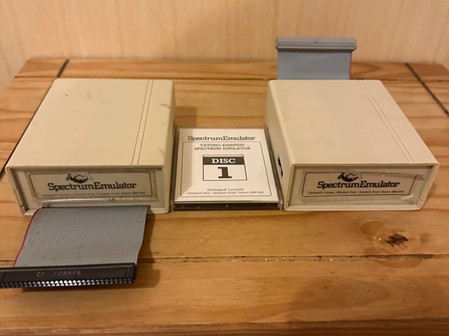
Relying on the fact that both the Tatung Einstein and the Sinclair ZX Spectrum use the same Z80 processor, Tony’s solution consisted of a mixture of hardware and software. Using two custom logic arrays and a 2K memory chip to impersonate the Spectrum keyboard and cassette port. The Speculator then uses 64k of ram with separate video memory to emulate the Spectrums display, the first 48K being used as the Spectrums normal 48k ram and the remaining 16k holding Tony’s machine code which emulates the Spectrum Rom and everything else.
A good start, but just the beginning, Tony then had to re-write the Spectrums tape loading routines (mainly to avoid copyright problems) after which, being a perfectionist, he added emulation of the Spectrums flashing border (that all Spectrum owners expect to see). Other routines were then called normal with the code modified appropriately so that it worked seamlessly with the different hardware. Where some parts of the Spectrum ROM were not required, Tony used the space left by to slot in his new code.
The display then provided the next challenge, luckily the Spectrum ULA and the Einstein’s Texas Instruments video chip were both capable of producing the same 256 by 192 dot resolution but as Tamara Knight explains in her article in Crash Magazine issue 36
“It is not memory-mapped, so the processor has to talk to it character by character through ‘ports. This makes it much slower than the Spectrum, but Tony found an ingenious quirk which allows him to update any sixth of the screen 50 times a second, funneling information from the Spectrum’s display area, where the games put it, through the ports”.
The Speculator then handles sound using a Piezo Speaker and the hardware emulation is complete.
Each Spectrum game supported by the Speculatorwas then reliant on additional code in order to load the original game. Supportfor this was provided in the form of Compilation disks released for theEinstein.
Each of these disks provided the code for up to20 games. The relevant code was then loaded along with the original spectrum cassette, and the game was then fully playable. In order to avoid frustration each game when loaded in this way could then be saved directly to a disk in the Einstein for future loading.
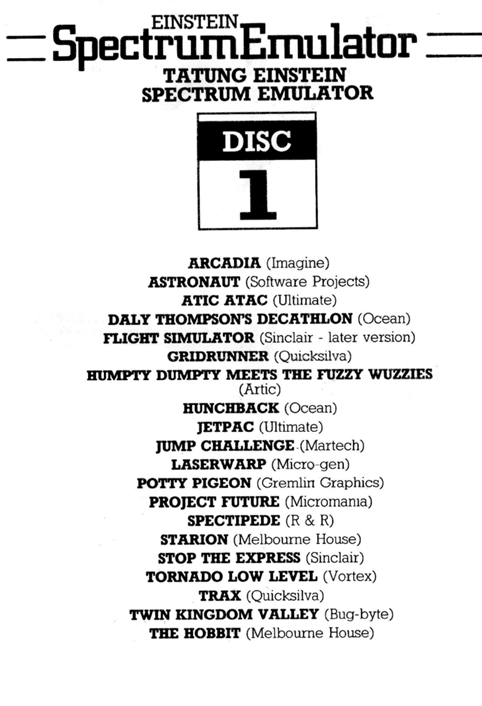

In total there were 3 compilation disks originally released along with publications covering the usage and addition of more codes for other games, the publication “Beyond The Spectrum Emulator” by Leslie T Smith adding 100 additional Game Codes.
One of the greatest assets of the Speculator at the time was that it had joystick support, which was either through an Einstein Joystick or the use of the Einsteins Cursor Keys and keyboard support was surprisingly straight forward (the exception being the right hand shift key which emulates the Spectrum’s Symbol Shift). Today Joysticks for the Einstein are of course non-existent (or are they? the answer to that is for another article on another day).
So there you have it a short history of the amazing work of one man, I shall now leave the last, somewhat inspirational words of this part of the article to the amazing Tony Brewer himself
“I don’t think there’s anything that can’t be done with a computer, if you think about it,”
Previous articlescovering the progress of this project include
Part 1 - The Einstein Speculator - My Story and whatleads to the thought behind the recreation of the Einstein Speculator.
Future articlescovering the progress of this project include
Part 3 - “Turning a thought into a Prototype”.
Part 4 - “The Testing Phase” using prototypescreated by a very talented engineer
Part 5 - “My Attempt to Build One Myself”.
All articles and updates on progress will appear so please check back regularly for updates.\]
The Future of the Einstein Speculator
Today, there are a few individuals working on the recreation of the Speculator. Using the original design, with some chip changes due to availability and a more up to date case, these individuals have achieved a great deal in a very short period of time, for my part I started the ball rolling on the Facebook User Group which attracted the attention of others, the results of whose efforts have now identified all the components and where necessary modern day replacements, created dumps of the original PAL chips ,commenced (and nearly completed) the creation of the Gerber files necessary to recreate the circuit boards and much more, all of which means we are very close to creating prototypes for testing.
I shall refrain from going any further at present or naming those that have been involved (mainly because I need to check they are happy for their names to be given out) until one of my later articles on the Speculator.
Those wishing to know more or read future articles should check back here on a regular basis as I will be ensuring all further progress is documented in a like manner.
Part 2 of this series of articles will cover “The Story Behind my love of the Einstein and what led up to the idea of recreating of the Einstein Speculator.